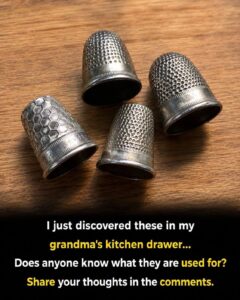
It is small enough to disappear inside a sewing box.
It weighs almost nothing.
It has no complicated mechanism, no moving parts, and no obvious connection to the great inventions of history.
Yet the humble thimble has survived for thousands of years.
Today, many people recognize a thimble as the small protective cap placed over a finger while sewing.
It may seem like an ordinary household object.
But behind that tiny piece of metal, leather, bone, or plastic is a remarkable story about human craftsmanship.
The history of the thimble is closely connected to one of humanity’s oldest skills: making things by hand.
Why Did People Need Thimbles?
Before modern sewing machines, much of the world’s clothing and household fabric was produced by hand.
Needles were pushed through leather, wool, linen, cotton, and other materials.
That could require considerable force.
A needle might be easy to push through thin fabric, but thicker materials could resist.
Repeatedly pressing a needle with the fingertip could become painful.
A thimble solved the problem in a remarkably simple way.
Instead of pushing directly against the needle with a bare finger, the sewer could place the thimble over a fingertip and use it to push the needle through the material.
The tiny protective cap distributed pressure and protected the skin.
It was a simple invention designed around a very practical problem.
Its Origins Go Back Very Far
The exact origins of the thimble are difficult to establish because early examples were often made from materials that didn’t survive.
Long before metalworking became widespread, people worked with materials such as bone, leather, wood, and stone.
Early finger protectors may have been simple pieces of material designed to protect the hand while working with needles or other sharp tools.
Archaeological discoveries have revealed early sewing implements from ancient cultures, showing just how old needlework itself is.
The basic idea was probably not invented once by a single person.
Different communities may have independently developed ways to protect their fingers while sewing and working with tough materials.
Ancient Metal Thimbles
By the Roman period, metal thimbles were being produced.
Bronze examples have been discovered and provide evidence of how sewing technology was developing alongside metalworking.
These early thimbles were primarily functional.
They didn’t need elaborate decoration.
Their purpose was simple: protect the finger and make repetitive handwork easier.
Similar protective sewing tools have also been associated with ancient civilizations in other parts of the world.
This reminds us that the basic challenges of sewing were shared across cultures.
Wherever people stitched clothing, leather goods, bags, footwear, or other materials, protecting the fingers could be useful.
The Medieval Thimble
As textile production expanded during the Middle Ages, sewing became an essential part of everyday life.
Clothing had to be made and repaired.
Household textiles required maintenance.
Tailors, embroiderers, leather workers, and other craftsmen spent hours working with needles.
Thimbles became increasingly practical tools.
Many European examples were made from brass or bronze.
Some were cast.
Others were hammered or shaped by hand.
Their surfaces were often covered with small indentations or dimples.
These weren’t merely decorative.
The textured surface helped prevent the needle from slipping when the thimble was used to push it through fabric.
That distinctive pattern became one of the most recognizable characteristics of the traditional thimble.
Nuremberg and the Rise of Production
By the 15th and 16th centuries, Nuremberg had become an important center for metalworking and thimble production.
German craftsmen developed increasingly refined manufacturing methods.
Improved alloys and production techniques allowed them to create stronger and more consistent thimbles.
Instead of every object being completely unique, craftsmen could produce larger numbers of similar pieces.
This was an important development.
The thimble was becoming more than an occasional handmade object.
It was becoming a recognizable household and professional tool.
More Than a Tool
As metalworking became more sophisticated, thimbles began changing in appearance.
Practical brass and bronze examples remained common, but decorative versions began appearing.
Some were made from silver.
Others featured engraving, patterns, or special designs.
The transformation was significant.
The thimble was no longer simply something that protected a finger.
It could also become a personal object.
A gift.
A souvenir.
A keepsake.
Or a symbol of craftsmanship.
Thimbles as Gifts
During the 18th and 19th centuries, decorative thimbles became increasingly popular.
A small silver thimble could make an attractive gift.
It could be engraved with initials, names, dates, or decorative designs.
Because a thimble was small and useful, it could also carry sentimental meaning without being excessively expensive.
Some were given to commemorate important occasions.
Others became family heirlooms.
A tiny object could therefore connect generations.
A grandmother’s thimble might eventually be passed to a daughter or granddaughter.
The object itself was small.
The story attached to it could be enormous.
The Industrial Revolution Changes Sewing
The Industrial Revolution transformed textile production.
Factories increasingly produced clothing and fabrics on a large scale.
Sewing machines eventually changed how garments were constructed.
As machines became more widespread, the amount of hand sewing required for mass production declined.
That naturally changed the role of the thimble.
It remained useful for hand sewing, repairs, quilting, embroidery, and specialized crafts, but it was no longer an essential tool for every household task.
Yet it never completely disappeared.
Why Thimbles Survived
One reason is simplicity.
There isn’t much that can go wrong with a traditional thimble.
It doesn’t require electricity.
It doesn’t need batteries.
It doesn’t need software.
It simply protects the finger.
That makes it one of those rare tools whose basic design has remained useful despite enormous technological change.
Modern versions may be made from metal, leather, rubber, silicone, or plastic.
Some are designed specifically for quilting.
Others are intended for embroidery or specialized crafts.
But the fundamental idea remains the same.
Protect the finger.
Push the needle.
Continue the work.
The Thimble as a Collectible
Today, antique and vintage thimbles have become collectible objects.
Collectors may search for pieces based on age, material, manufacturer, craftsmanship, decoration, or historical significance.
Some collections contain hundreds of examples.
There are tiny silver thimbles with intricate engraving.
There are unusual souvenir thimbles produced to commemorate places or events.
There are highly decorative pieces that look more like miniature works of art than sewing tools.
Because they are small, thimbles are also relatively easy to preserve and display.
A collector can build an impressive historical collection without needing an enormous amount of space.
A Tiny Record of Human Creativity
Perhaps the most fascinating thing about the thimble is how ordinary it seems.
It doesn’t look like an invention that changed civilization.
It didn’t revolutionize transportation.
It didn’t produce electricity.
It didn’t communicate across continents.
Instead, it solved a tiny everyday problem.
A needle hurts your finger.
So someone created a protective cap.
That solution was so useful that it survived for thousands of years.
The design evolved.
Materials changed.
Manufacturing improved.
Decoration became more elaborate.
But the original purpose remained.
More Than Just Metal
A thimble can also tell us something about the people who used it.
Think about the hours of work represented by an old sewing tool.
Someone may have used it to repair a child’s clothing.
Another person may have used it to create an embroidered design.
A tailor might have worn one every working day.
A grandmother might have used one while making clothes for her family.
The object carries evidence of a world where repairing and creating things by hand was a normal part of everyday life.
Why It Still Matters
Modern technology has made many tasks faster.
Clothing can be manufactured quickly.
Machines can stitch seams with extraordinary precision.
But handcrafting remains important.
People still quilt.
They embroider.
They repair clothing.
They make costumes.
They create handmade gifts.
And when they do, the thimble can still have a place in the sewing basket.
Its continued existence is a reminder that not every useful invention needs to become obsolete.
Sometimes a simple design is already close to perfect.
The Tiny Tool That Outlasted Generations
The history of the thimble is really a history of human persistence.
For thousands of years, people have made things with their hands.
They have stitched clothing, repaired belongings, decorated fabrics, and passed their skills from one generation to another.
The thimble helped make that work possible.
From ancient protective finger tools to Roman bronze examples, medieval brass thimbles, elaborate silver keepsakes, and modern sewing accessories, its basic purpose has remained remarkably consistent.
It protects the person doing the work.
And perhaps that’s why such a tiny object has endured.
The thimble doesn’t demand attention.
It simply does its job.
Small enough to fit on a fingertip, it carries centuries of craftsmanship in the palm of a hand.
And every time someone places one on a finger before beginning to sew, they are continuing a tradition far older than the modern world itself.