I never expected a hotel room to teach me something about nature.
I had checked into the hotel expecting the usual experience.
A quiet room.
A comfortable bed.
A quick shower.
Then perhaps a little rest before heading out again.
Nothing unusual.
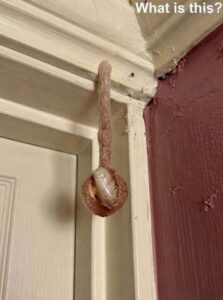
But as I was putting my things away, something caught my attention in one corner of the room.
At first, I thought it was simply a piece of dried dirt.
It was small.
Brown.
Irregularly shaped.
And attached to the wall.
I almost ignored it.
Then I looked again.
There was something about the shape that didn’t look accidental.
It seemed to have been deliberately constructed.
I stepped closer.
That’s when I realized I was looking at a mud dauber nest.
What initially looked like a lump of dried mud was actually a tiny structure built by an insect.
And suddenly, an ordinary hotel room became a surprisingly interesting place to observe nature.
A Tiny Builder at Work
Mud daubers are wasps known for constructing nests from mud.
Unlike the large social wasp colonies many people imagine when they hear the word “wasp,” mud daubers are generally solitary insects.
A female mud dauber collects wet mud from suitable locations.
She carries small amounts back to the nest site and builds with them.
Piece by piece, she creates chambers where her young will eventually develop.
The construction process is surprisingly precise.
The insect isn’t simply throwing mud against a wall.
It gathers material, transports it, places it, and shapes it into a functional structure.
What looks like a simple lump from a distance can therefore represent a considerable amount of work.
Why Build With Mud?
Mud is an incredibly useful natural building material.
It’s abundant.
It’s easy to collect.
And once it dries, it becomes surprisingly hard.
Mud daubers take advantage of these properties.
The nest provides protection for the developing young.
Inside individual chambers, the female provisions food for the larvae before sealing the cells.
The details vary between different species, but the basic strategy is fascinating.
The mother doesn’t simply build a shelter.
She prepares individual spaces and supplies them with food so that the developing offspring have resources available.
All of this happens without blueprints, measuring tools, or machinery.
A Hotel Is an Unusual Place to Find One
Finding a mud dauber nest inside a hotel room may seem strange.
But insects don’t understand human ideas about where nature “belongs.”
A building can provide shelter, walls, protected corners, and other features that make a location suitable for nesting.
A quiet corner may appear to be a perfectly reasonable construction site from an insect’s perspective.
The creature isn’t thinking about whether the building is a hotel.
It’s simply responding to its environment.
That is part of what made the discovery so interesting.
Nature doesn’t necessarily disappear when people build structures.
It often adapts.
Should You Be Afraid?
For many people, the word “wasp” immediately creates anxiety.
That’s understandable.
Nobody wants to be stung.
But mud daubers are generally not considered aggressive toward people, and they are solitary rather than highly defensive social insects.
That doesn’t mean they should be handled.
Any unfamiliar insect should be given space.
The safest approach is simple:
Observe rather than disturb.
If a nest is located somewhere that creates a practical concern, hotel staff or another appropriate professional can determine how it should be handled.
There is rarely a good reason to poke, break, or remove a nest yourself.
A Predator With an Important Role
Another fascinating aspect of mud daubers is their diet and hunting behavior.
Many mud dauber species capture spiders.
The female may locate a spider, immobilize it, and carry it back to her nest.
The spider becomes food for her developing offspring.
From a human perspective, this may sound unpleasant.
From an ecological perspective, it’s simply part of the food web.
Mud daubers therefore contribute to controlling populations of spiders and other small creatures.
They aren’t just random insects building strange structures.
They’re participating in a much larger ecological system.
The Architecture Is the Amazing Part
Think about the amount of coordination involved.
The insect has to locate suitable mud.
Transport it.
Return to the nest.
Build the structure.
Create chambers.
Find prey.
Transport the prey.
Place it appropriately.
Lay an egg.
Seal the chamber.
Then repeat the process.
All of this is performed by a tiny creature operating on instinct and environmental cues.
The finished nest may look crude to human eyes.
But its purpose is remarkably sophisticated.
It is a nursery, food storage system, and protective structure combined into one small construction.
Why We Miss Things Like This
One reason the discovery surprised me was that I almost didn’t see it.
I was focused on my luggage.
My plans.
My phone.
The next place I needed to be.
The little nest was right there.
Nothing about it demanded attention.
It didn’t make noise.
It didn’t move.
It didn’t flash or glow.
It simply existed.
That is probably true of countless other natural wonders around us.
We pass insects, plants, fungi, birds, nests, and tiny ecosystems every day without noticing them.
Sometimes the difference between an ordinary moment and a memorable one is simply whether we stop to look.
A Different Kind of Souvenir
People often return from trips with photographs of famous buildings, beaches, monuments, and restaurants.
Those are wonderful memories.
But sometimes the unexpected discoveries are more memorable.
A strange nest in a hotel room.
A bird outside the window.
A lizard hiding near a doorway.
A butterfly resting on a suitcase.
These encounters aren’t usually included in travel guides.
They happen by chance.
And because they’re unexpected, they can remain in our memories for years.
What to Do If You Find One
If you discover a mud dauber nest, the first step is to avoid disturbing it.
Keep children and pets away from the area.
Don’t poke the nest to see what’s inside.
Don’t attempt to handle the insect.
If you’re staying at a hotel and the nest is somewhere inconvenient, tell the staff.
They can determine whether action is necessary.
If the nest isn’t causing a problem, simply observing it from a safe distance may be the easiest solution.
You can also take a photograph if you want to remember the discovery.
There is no need to turn every unexpected encounter with nature into an emergency.
Sometimes observation is enough.
Nature Doesn’t Need a Wilderness
The discovery also reminded me of something important.
We often imagine nature as something that exists far away.
We think of forests.
Mountains.
Rivers.
National parks.
Remote landscapes.
But nature is much closer than that.
It can exist in a city.
In a garden.
On a balcony.
Beside a sidewalk.
And, occasionally, on the wall of a hotel room.
Life constantly finds opportunities to survive and reproduce.
Even highly developed environments can contain tiny pockets of biological activity.
You just have to notice them.
A Small Lesson From a Tiny Builder
That mud dauber nest changed the way I looked at the room.
Before seeing it, the hotel was simply a temporary place to sleep.
Afterward, it felt like I had accidentally discovered a tiny natural history exhibit.
The nest represented patience, instinct, construction, survival, and adaptation.
It also reminded me that interesting discoveries don’t always announce themselves.
Sometimes they are just sitting quietly in a corner.
Waiting for someone to pay attention.
The Wonder of Looking Closer
I could have walked past that nest without giving it a second thought.
Instead, I stopped.
I looked closer.
I became curious.
And curiosity led me to learn about an insect I probably wouldn’t have thought about otherwise.
That’s perhaps the most valuable part of the experience.
Nature doesn’t always require a long hike or an expensive trip.
Sometimes it only requires a few extra seconds of attention.
The next time you see something strange—a small structure on a wall, an unfamiliar insect, an unusual pattern in a tree—take a moment before walking away.