The Box That Shouldn’t Have Been There
I didn’t go into my grandmother’s house expecting revelations.
I went in because time had done what time always does—it had moved forward without permission, without hesitation, without asking whether the rest of us were ready to follow.
Six months had passed since her absence, and the house had begun to feel like a paused sentence. Everything was intact, yet unfinished. The air itself seemed to wait for instructions.
Cleaning her closet was supposed to be simple.
Practical.
Necessary.
A task measured in folded fabric, labeled boxes, and quiet decisions about what to keep and what to release.
But grief is rarely practical.
It rearranges the meaning of ordinary things until even the simplest object feels like it has something to say.
Her closet still held her rhythm.
Coats arranged by season.
Shoes placed with quiet precision.
Scarves folded as if she might return tomorrow and expect them unchanged.
I kept thinking I would find closure there.
Instead, I found something else entirely.
Something that felt like it had been waiting.
The Object That Didn’t Belong to the Present
It was hidden behind a row of winter coats she hadn’t worn in years.
Not abandoned.
Not forgotten.
Hidden.
There is a difference, and I felt it immediately when I saw the box.
Small.
Cardboard.
Plain enough that I almost overlooked it.
But its placement was deliberate in a way that made my chest tighten slightly, though I couldn’t explain why.
My grandmother never hid things carelessly.
Even her secrets had order.
I sat on the floor before opening it.
Not out of hesitation exactly, but out of instinct—like I understood, before understanding, that what I was about to see would not remain contained inside the box.
The lid lifted quietly.
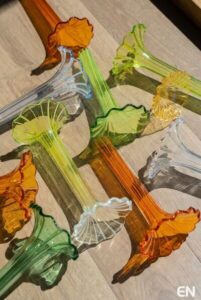
Inside were glass objects.
Delicate.
Unfamiliar.
Beautiful in a way that felt almost unsettling.
They were small tubes—too refined to be functional in any obvious modern sense. Some curved gently like softened water droplets. Others were straight and narrow, like fragments of something larger that had been carefully broken down into meaning.
Colors drifted inside them.
Faded blues.
Muted greens.
Soft pinks that looked like they had once belonged to flowers pressed between pages.
At the top of each one was a tiny metal hook.
Worn.
Oxidized.
Intentional.
I remember turning one in my fingers, trying to locate its purpose the way you try to solve a riddle you didn’t realize you had agreed to solve.
But it didn’t behave like a modern object.
It didn’t explain itself.
It simply existed.
And it felt like it knew something I didn’t.
The Great-Aunt Who Remembered What Time Forgot
I didn’t trust my own interpretation, so I brought one to the only person I thought might understand.
My great-aunt.
My grandmother’s older sister.
She lived in a smaller house filled with sharper memories—ones that hadn’t softened with time but had instead become more defined, like photographs that grow clearer the longer you look at them.
When she saw the object, she didn’t ask what it was.
She didn’t need to.
Her reaction was immediate.
Not surprise.
Recognition.
That quiet kind of recognition that doesn’t belong to curiosity, but to memory.
She held it carefully, almost reverently, like something fragile not because it could break, but because it carried weight.
“I haven’t seen these in decades,” she said.
Her voice changed slightly as she spoke, as if she had stepped backward in time without moving her feet.
I asked her what they were.
She smiled—not at me, but at the past.
“Miniature vases,” she said. “Men used to carry them.”
I blinked.
Because that sentence didn’t fit anything I understood about the world.
She noticed my confusion and continued gently.
“They weren’t decorative in the way we think of decoration now. They were personal. A single flower. One bloom. Carried in a pocket or pinned inside a coat. It was a gesture.”
“A gesture of what?” I asked.
Her eyes softened.
“Of attention.”
That word stayed with me longer than anything else.
Attention.
Not performance.
Not display.
Attention.
The Man I Never Met
Then she said something that shifted the air in the room.
“Your grandfather used them.”
I had never met him.
He existed in my life only as absence shaped into stories—fragments passed down carefully, never fully assembled.
But suddenly, he stopped being abstract.
He became someone with habits.
Preferences.
A ritual.
“He wore them every Sunday,” she said.
“One flower. Always fresh. He placed it in the vase and carried it when he took your grandmother for walks.”
I tried to imagine it.
A man choosing a flower.
Not for ceremony.
Not for occasion.
But for presence.
For the simple act of noticing beauty and deciding it should not be left behind.
People remembered him, she said.
Not for wealth.
Not for status.
But for that small, repeated gesture.
A single flower carried through ordinary streets like a quiet refusal to let the world become purely functional.
And my grandmother…
She didn’t throw them away.
She kept them.
All of them.
What We Inherit Without Knowing
When I returned home, something inside the house felt altered.
Not physically.
Emotionally.
As if the discovery had rewritten the past without changing any of its visible details.
I began noticing things I had always overlooked.
The way she always placed fresh flowers on the kitchen table every Sunday.
The way she paused near windows longer than necessary.
The way she treated small objects as if they were not small at all.
I had once mistaken her quietness for simplicity.
But it wasn’t simplicity.
It was preservation.
A life built around holding onto meaning without announcing it.
I found more boxes after that.
Pressed flowers.
Not random.
Not decorative.
Dated.
Organized.
Each one tied to something she never explained out loud.
Birthdays.
Losses.
Seasons.
Moments that had no official record but clearly mattered deeply to her.
It began to feel like I wasn’t discovering objects anymore.
I was reading a language I had never been taught.
Love That Does Not Announce Itself
The most difficult realization was not about the object.
It was about her.
Because I had misunderstood her.
I had thought she was distant in the way older people sometimes appear to be when younger generations assume emotional expression must be visible to be real.
But she wasn’t distant.
She was contained.
Her emotional life wasn’t absent.
It was structured differently.
It lived in repetition.
In small rituals.
In objects no one thought to question.
And the love she carried for my grandfather wasn’t loud.
It was consistent.
That was the difference I had missed.
Not intensity.
Continuity.
A kind of devotion that does not require witnessing to exist.
The Meaning Hidden in Small Things
I started thinking about attention differently after that.
Not as something given occasionally.
But as something practiced.
The vase wasn’t important because it was rare.
It was important because it was used.
Repeatedly.
Deliberately.
With care.
And the flower wasn’t symbolic in an abstract sense.
It was literal.
Alive.
Temporary.
Chosen each time with awareness that it would not last forever.
That fragility was part of the meaning.
There is something deeply human about choosing impermanence on purpose.
Something that resists modern logic.
Something my grandmother understood long before I did.
The House That Became a Memory
By the time I finished sorting through her things, the house no longer felt like a place of absence.
It felt like a structure built out of memory itself.
Every drawer held continuity.
Every object had context.
Nothing was random.
Nothing was careless.
Even silence had pattern.
And I realized something I hadn’t expected:
She had not left me a mystery to solve.
She had left me a way of seeing.
What I Chose to Keep
I kept the glass vases.
Not as artifacts.
Not as decoration.
But as continuation.
I placed one near a window where light changes throughout the day.
And I did something small.
Something ordinary.
Something she would have understood without explanation.
I placed a single flower inside it.
Not because I thought it would preserve the past.
But because I understood, finally, that it was never about preservation.
It was about participation.
The Bridge Between Then and Now
We tend to believe we know the people closest to us.
We reduce them into roles we can manage emotionally.
Grandmother.
Mother.
Wife.
We forget that each of those roles contains an entire private world that may never be fully shared.
What I found in that closet wasn’t just an object.
It was evidence of that hidden world.
A world where love was not declared but practiced.
Where memory was not spoken but maintained.
Where meaning lived inside small, repeated gestures that never asked to be witnessed in order to matter.
And in understanding that, something inside me shifted.
Not dramatically.
Quietly.
Permanently.
Because I realized that inheritance is not always material.
Sometimes it is behavioral.
Sometimes it is emotional.
Sometimes it is the way we learn—without realizing it—to notice beauty in small things and treat them as if they matter.
Final Reflection
Now, when I see a single flower, I don’t see decoration.
I see intention.
I see attention.
I see a man I never met choosing something fragile to carry into an ordinary day.
And I see a woman I did know, carrying the echo of that choice through the rest of her life without ever needing to explain it.
What I discovered in that closet was not just history.
It was continuity disguised as silence.
And once you see that kind of continuity, you stop looking at the past as something finished.