For most people, a birthday is supposed to be a celebration.
It is a day filled with candles, laughter, photographs, presents, and wishes whispered quietly before the flames are blown out.
For me, birthdays became something else.
They became reminders.
Reminders of an empty chair.
A missing voice.
A face that looked almost exactly like mine, yet disappeared from my life so completely that, after enough years had passed, I sometimes wondered whether I had imagined having a twin at all.
Her name was Laura.
She was born seven minutes before me.
And on the night we turned sixteen, she vanished.
For nearly forty years, I carried the same question with me:
What happened to my sister?
I searched for answers everywhere.
I searched through old photographs and newspaper clippings. I reread police reports. I listened carefully whenever my parents spoke about the past. I examined memories that had become increasingly faded with time.
Sometimes I even searched my dreams.
But the most painful secrets are not always buried somewhere far away.
Sometimes they are hidden inside the walls of the place where you grew up.
And sometimes, after decades of silence, the truth returns when you least expect it.
For me, that truth arrived in the form of an old cream-colored sweater.
A sweater decorated with a yellow sunflower.
And something small and wooden hidden beneath it.
Chapter One: Seven Minutes Apart
People often asked what it was like to have an identical twin.
Laura and I never really knew how to answer.
Being twins was simply our normal life.
We shared a bedroom until we were thirteen. We had matching bicycles when we were children. We watched the same cartoons, complained about the same vegetables, and knew exactly which songs could make the other cry.
We could recognize each other’s footsteps.
We knew each other’s expressions.
Sometimes we could communicate with a glance without saying a word.
Yet despite looking almost identical, we were completely different personalities.
I was cautious.
Laura was fearless.
I liked routines.
Laura hated them.
I preferred books, quiet afternoons, and knowing what the next day would bring.
Laura wanted adventure.
She wanted to climb trees, sneak down to the lake after dark, and talk to complete strangers as though they had been friends for years.
Our mother used to describe us perfectly.
“You’re the anchor,” she would tell me.
Then she would look at Laura.
“And you’re the wind.”
I didn’t understand what she meant then.
I understand now.
Our father was different.
He was a serious man who believed strongly in rules, responsibility, and reputation. He worked long hours at a manufacturing plant and expected the household to run according to a predictable schedule.
Dinner was at six.
Homework came before television.
Shoes belonged by the door.
And children were expected to follow their parents’ rules.
Laura challenged nearly all of them.
The older she became, the more determined she was to create a life beyond our small town.
She wanted to travel.
She wanted to see cities she had only read about.
She wanted to meet people our father would never have allowed through the front door.
And then she met Daniel.
That was when everything began to change.
Chapter Two: The Boy My Father Never Accepted
Daniel was seventeen when Laura met him.
He lived across town with his mother and younger brother. He had dark hair, a crooked smile, and an old motorcycle that our father considered a symbol of everything he disliked about teenage rebellion.
The first time Laura brought him home, Dad barely spoke.
He shook Daniel’s hand.
Asked him a few questions.
Then spent the rest of dinner looking as though he had discovered something unpleasant at the table.
Afterward, Dad told Laura that Daniel was not welcome in our home again.
Laura ignored him.
That was the beginning of months of arguments.
She started staying out later.
Dad started waiting awake for her.
Our mother tried to keep peace between them, but the tension inside the house became impossible to ignore.
I was caught between them.
Laura would come into our bedroom after midnight and whisper about her plans.
She wanted to leave town.
She wanted to finish school somewhere else.
Most of all, she wanted to prove that she could make her own decisions.
I tried to convince her to slow down.
She would smile and tell me not to worry.
“You worry enough for both of us,” she once said.
I remember laughing.
I remember wishing I could believe her confidence would protect her.
I didn’t know how little time we had left.
Chapter Three: The Sixteenth Birthday
Our sixteenth birthday began normally.
There were balloons in the kitchen.
Our mother baked a chocolate cake.
Our parents gave us matching necklaces.
For a few hours, everything felt almost peaceful.
Laura even seemed happy.
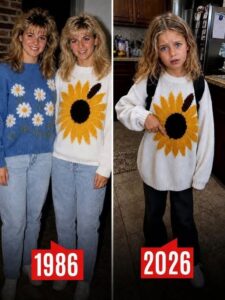
She wore her favorite cream-colored sweater with the yellow sunflower on the front.
I remember that detail because she had received it only a few weeks earlier.
She loved it.
She said the sunflower reminded her that some things could still grow even in difficult places.
That evening, after dinner, Laura disappeared upstairs.
When she came back down, she was carrying a small bag.
I asked where she was going.
She smiled.
“Just out for a little while.”
I knew immediately that something was wrong.
Daniel’s motorcycle was waiting at the end of the street.
I followed Laura toward the door.
“Don’t,” I whispered.
She turned around.
For a moment, we simply looked at each other.
Then she hugged me.
It was not a normal hug.
It lasted longer.
Almost as if she knew it might be the last one.
“Tell Mom I love her,” she whispered.
Then she walked away.
That was the last time I saw my sister.
Chapter Four: The Empty Chair
By midnight, everyone knew Laura was missing.
Our father called the police.
Our mother cried until she could barely speak.
I sat on the stairs clutching Laura’s necklace and replaying our final conversation in my head.
The police asked questions.
Had she threatened to leave?
Had she mentioned running away?
Did she have a boyfriend?
Did she have money?
Did she have somewhere to go?
I told them everything I knew.
But there was one thing I did not tell them.
I had seen Dad arguing with Laura earlier that evening.
I had heard him say:
“If you walk out that door, don’t expect to come back.”
I was afraid that telling the police would make everything worse.
So I stayed silent.
That silence would follow me for decades.
Chapter Five: Forty Years of Questions
Laura’s disappearance never received a satisfying explanation.
Daniel disappeared from town soon afterward.
Our father insisted he knew nothing about where Laura had gone.
Our mother rarely mentioned her.
As the years passed, the family changed.
I left home.
I married.
I had children.
My parents grew older.
But every birthday remained difficult.
I could never stop wondering what Laura’s life might have become.
Was she alive?
Had she built a family?
Did she ever think about me?
Did she remember our sixteenth birthday?
I kept searching.
Then, forty years later, my mother died.
While cleaning out the old family house, I opened a wooden trunk that had belonged to her.
Inside were photographs, letters, old clothes, and childhood keepsakes.
At the bottom was the cream-colored sweater.
The sunflower was faded.
I picked it up.
Something fell from beneath it.
A small wooden box.
Inside was a photograph.
Laura was standing beside a young woman I didn’t recognize.
On the back, written in my mother’s handwriting, were six words:
“She asked me to keep this.”
Beneath the photograph was an address.
An address in another state.
My hands began to shake.
For forty years, I had believed my sister had simply disappeared.
But suddenly I understood something terrifying.
Someone in our family had known more than they had ever told me.
And for the first time in four decades, I had a place to begin looking forLaura.