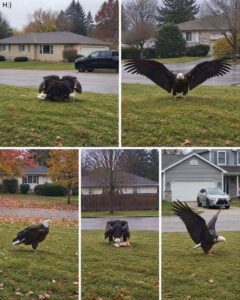
The first reports seemed almost impossible to believe. Hikers near Brownsville, Texas, claimed they had witnessed a gigantic bird soaring high above the landscape, casting an unusually large shadow across the ground. At first, the reports sounded like exaggerated descriptions of an ordinary wildlife encounter. But as the story spread, people began asking an intriguing question: could a bird of extraordinary size really be living near the Texas–Mexico border?
According to the circulating account, witnesses described a powerful raptor with a wingspan approaching ten feet. That would be considerably larger than the wingspan of most bald and golden eagles, two of North America’s best-known birds of prey.
The story claims that wildlife specialists eventually located the mysterious bird using cameras and tracking equipment before transporting it to a conservation facility for examination. If verified, such an encounter would raise fascinating questions about the animal’s identity, anatomy, and evolutionary history.
However, there is an important distinction between an extraordinary wildlife story and a confirmed scientific discovery. The specific claims about a giant eagle captured near Brownsville, its alleged DNA results, and its examination by researchers have not been independently verified here. Nevertheless, the subject offers an opportunity to explore what scientists would investigate if they encountered a genuinely unusual bird of prey.
An Unusual Sighting Near the Texas–Mexico Border
Southern Texas is home to a wide variety of wildlife. Its coastal wetlands, grasslands, agricultural areas, and river habitats support numerous bird species, including migratory visitors and powerful predators.
Brownsville’s location near the Mexican border makes the surrounding region particularly interesting for birdwatchers. Depending on the season, different species can move through the area in search of food, suitable nesting locations, or favorable weather conditions.
Large birds can easily attract attention when they appear unexpectedly. Their broad wings and ability to soar effortlessly above the ground can make them seem enormous, especially when viewed from a distance.
Perspective can also distort our perception of size. Without a nearby object for comparison, estimating a bird’s wingspan accurately is difficult. Camera zoom, lighting, and the angle of observation can make an animal appear substantially larger than it really is.
For this reason, wildlife researchers would need more than witness descriptions to establish the identity of a supposedly giant eagle.
Clear photographs, video recordings, precise measurements, and independent observations would all help determine whether the animal was unusually large or simply an unfamiliar species.
How Big Can an Eagle Really Become?
Eagles are among the most impressive living birds of prey. Their powerful talons, hooked beaks, excellent eyesight, and broad wings make them highly effective hunters.
The bald eagle is particularly recognizable because of its white head and tail in adulthood. Golden eagles, by comparison, have predominantly brown plumage with golden feathers around the back of the head and neck.
Both species can develop wingspans exceeding six feet, and particularly large individuals can approach or exceed seven feet.
A wingspan approaching ten feet would be exceptional for a living eagle and would require careful measurement before scientists accepted the claim.
Researchers would need to determine whether the wings were fully extended and whether the reported figure represented a direct measurement or an estimate based on photographs.
They would also examine the bird’s body mass, wing shape, feather structure, and overall proportions.
Large wings help birds generate lift, but increasing body size creates additional physical challenges. A heavier animal needs sufficient wing area, powerful flight muscles, and an efficient respiratory and cardiovascular system.
The relationship between size and flight is complex. A bird cannot simply grow larger without changes to its anatomy and energy requirements.
That is why an exceptionally large raptor would attract scientific interest while also requiring convincing evidence.
What Would Scientists Examine First?
If wildlife professionals encountered a bird with unusual dimensions, their first priority would be to document its physical characteristics and assess its health.
They would measure its wingspan, body length, weight, beak, legs, and other relevant features. Photographs from multiple angles would allow specialists to compare its appearance with documented examples of known species.
Feather patterns would also be important. Many raptors have distinctive markings that change as they mature, meaning that age can influence identification.
Researchers would examine the bird for injuries, abnormalities, and signs of disease. An unusual appearance might result from a medical condition, abnormal feather growth, or individual variation rather than an entirely different species.
The bird’s sex and age could also influence its size. In some raptor species, females are noticeably larger than males.
If the animal appeared healthy but remained difficult to identify, scientists might compare its measurements with museum specimens and established wildlife databases.
Any examination involving capture or handling would need to be conducted by trained professionals under appropriate wildlife permits and animal-welfare protocols.
The goal would be to establish the facts before drawing conclusions about the bird’s identity.
Could DNA Testing Reveal an Unknown Species?
Modern genetic analysis has transformed wildlife research. Scientists can use DNA to identify species, investigate evolutionary relationships, study population differences, and explore the causes of unusual biological characteristics.
If a bird displayed features that did not match any known raptor, researchers might analyze an appropriately collected biological sample and compare its genetic profile with authenticated reference material.
The results could help determine whether the animal belonged to a recognized species or represented an unusual population.
However, DNA testing does not automatically reveal the identity of every unfamiliar animal. The usefulness of the results depends on sample quality, the availability of reliable reference sequences, and the methods used during analysis.
An incomplete reference database can make identification difficult, particularly when researchers are studying rare populations.
Scientists would also need to rule out contamination, laboratory errors, and sample mix-ups before interpreting unusual results.
Even a genetic difference would not necessarily establish a new species. Researchers would need additional evidence, potentially including anatomical comparisons, population data, and further genetic analysis.
For the alleged Texas eagle, no verified genetic findings have been established in the information provided.
The Feather Clues That Could Reveal Its Journey
Feathers can tell researchers much more than what a bird looks like.
Depending on the species and the condition of the material, feather analysis can help scientists investigate diet, environmental exposure, and aspects of an animal’s history.
Stable isotope analysis, for example, can reveal clues about the geographic regions and food sources associated with feather growth.
Because feathers develop over time, their chemical composition may preserve information about where a bird obtained its food during a particular stage of its life.
However, feathers cannot independently provide a complete migration map. Researchers would need to interpret the results alongside other information, such as GPS tracking, banding records, or repeated observations.
If an unusually large raptor were confirmed near Brownsville, scientists could investigate whether it was a local resident or a visitor from another region.
Tracking equipment might help reveal its movements, feeding areas, and seasonal behavior.
Such information would be valuable for understanding the animal’s ecology, regardless of whether its size proved exceptional.
Why Scientists Study Extinct Giant Eagles
One of the most fascinating comparisons mentioned in the story involves Haast’s eagle, an extinct bird of prey that lived in New Zealand.
Haast’s eagle was an enormous predator adapted to hunting large flightless birds, including moa. Its powerful legs and talons helped it capture substantial prey, making it one of the most remarkable raptors known from the fossil record.
The species evolved in an unusual island ecosystem where large flightless birds provided an important food source.
Its extinction followed major ecological changes associated with human settlement and the decline of its prey.
Studying Haast’s eagle helps scientists understand how evolution can produce exceptionally large predators under particular environmental conditions.
Its anatomy also offers clues about the relationship between body size, hunting behavior, and flight performance.
However, Haast’s eagle lived in New Zealand and is known from historical and fossil evidence. Its existence does not establish that a similar giant eagle currently lives in Texas.
Comparisons with extinct animals can guide scientific questions, but they cannot replace direct evidence about a modern animal.
Could a Giant Eagle Have Remained Undiscovered?
Scientists continue to discover new species around the world, demonstrating that biodiversity remains incompletely documented.
However, a previously unknown bird with a wingspan approaching ten feet would present a particularly challenging case.
Large birds are often visible over considerable distances. They may leave identifiable feathers, nests, feeding remains, and other traces of their presence.
Birdwatchers, researchers, photographers, and conservation organizations also monitor many habitats where large predators live.
These factors make a resident population of enormous eagle-like birds difficult to overlook indefinitely.
If a remarkably large bird were reported, researchers would initially investigate more conventional explanations, including misidentification, an unusually large individual of a known species, or an inaccurate size estimate.
A new species would remain a possibility to investigate only if reliable evidence supported that conclusion.
Repeated observations, physical measurements, and independently confirmed documentation would be essential before scientists could responsibly announce such a discovery.
Why Protecting the Bird Would Matter
Unusual wildlife sightings can attract public attention very quickly. Once photographs or dramatic descriptions begin circulating online, curious visitors may attempt to locate the animal themselves.
That attention can create problems for wildlife.
Crowds may disturb feeding or resting behavior, while approaching too closely can cause stress or encourage an injured animal to move into a dangerous location.
If researchers genuinely encountered a rare or unusual raptor, protecting its welfare would be an important priority.
Wildlife professionals could establish appropriate observation distances, limit access to sensitive areas, and provide guidance to the public.
A conservation facility might be appropriate if the animal required rehabilitation or specialized care, but capturing and transporting a healthy wild bird would not automatically be necessary.
In many cases, observing wildlife in its natural habitat provides better information about its behavior and ecology.
Any decision to handle or relocate an animal would need to consider its health, conservation status, legal protections, and the potential consequences of intervention.
What Happens Next?
The story of a giant eagle near Texas raises fascinating questions about animal size, evolutionary history, and the limits of human knowledge.
A verified raptor with a wingspan approaching ten feet would warrant careful investigation. Researchers would need to establish its measurements, identify its species, assess its health, and determine whether its characteristics fell within known biological variation.
Genetic analysis, anatomical studies, feather research, and tracking could all contribute to that investigation.
But until reliable evidence becomes available, the specific claim that scientists captured such a bird near Brownsville should be treated as unconfirmed.
The real lesson is that extraordinary wildlife discoveries require more than dramatic sightings. They require verifiable evidence, careful scientific analysis, and independent confirmation.
The natural world remains full of remarkable animals, from powerful living eagles to enormous extinct predators. Understanding them depends on curiosity balanced with a willingness to question surprising claims.
Whether this particular story eventually gains credible evidence or remains an unverified account, the science behind giant birds of prey offers a compelling reminder of how evolution shapes life in extraordinary ways.