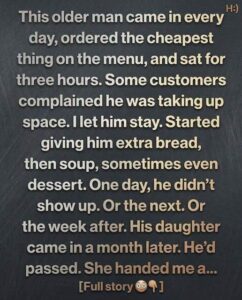
Every afternoon, an elderly man entered my café and ordered the cheapest item on the menu. Sometimes he chose coffee and toast; other days, he settled for a small bowl of soup. He always sat beside the window, unfolded his newspaper, and remained there for hours without asking for anything he couldn’t afford.
Some customers complained that he occupied a table during the busiest hours, but I never asked him to leave.
Instead, I began bringing him extra bread, a bowl of soup, or a slice of pie that would otherwise go to waste. He accepted everything with a grateful nod, never explaining his circumstances or making me feel that my kindness deserved recognition.
His name was Arthur. I learned that during our brief conversations, although he rarely spoke about himself. He was polite, soft-spoken, and always dressed in the same brown coat, even when the weather grew warm.
One rainy afternoon, I noticed his hands trembling as he struggled to open a sugar packet.
“Are you all right, Mr. Arthur?” I asked.
He smiled faintly. “Just getting older, I suppose.”
I offered to bring him something warm to eat.
“No, thank you,” he replied. “I’ve already ordered.”
His answer stayed with me long after I returned to the kitchen. There was something about the way he said it that made me realize he wasn’t simply being polite. He was protecting his pride.
From that day forward, I made sure his coffee came with a fresh sandwich or a warm bowl of soup. I never charged him extra, and I never mentioned it. Whenever he tried to thank me, I told him the kitchen had prepared too much.
He always knew I was lying, but he never exposed me.
Weeks turned into months. Arthur became part of the café’s daily rhythm. He would arrive shortly after two, sit by the window, and watch people hurry through the streets. Occasionally, he told me stories about his younger days, his late wife, and a daughter he hadn’t seen as often as he would have liked.
“My daughter is a good woman,” he told me one afternoon, stirring his coffee. “She has a family of her own now. Life gets busy.”
“Do you see her often?” I asked.
He looked down at his cup.
“Not as often as I’d like.”
I wanted to ask more, but something in his expression stopped me.
Then, one afternoon, his usual chair stood empty.
I assumed he had an appointment or was feeling unwell. The next day, I glanced at the door several times, expecting to see his familiar brown coat.
He didn’t come.
A day passed, then another, until an entire week went by without seeing him.
I asked a few regular customers whether they had seen him around town. Nobody knew anything. I considered visiting the nearby neighborhood, but I realized I didn’t even know where he lived.
Nearly a month later, a woman entered the café carrying a small leather handbag. She looked to be in her forties, with tired eyes and an expression that suggested she had been carrying something heavy for a long time.
She approached the counter.
“Are you the owner?” she asked.
“Yes. How can I help you?”
“My name is Eleanor. My father used to come here every afternoon. His name was Arthur.”
My heart sank.
“Arthur? Is he all right?”
She lowered her eyes and took a slow breath.
“My father passed away three weeks ago.”
For a moment, the noise of the café seemed to disappear. I remembered his quiet smile, his brown coat, and the way he always thanked me for the smallest things.
“I’m so sorry,” I whispered.
Eleanor nodded, fighting back tears.
“He talked about you constantly during his final days. He told me that there was a café owner who treated him like a person when he felt the rest of the world had forgotten him.”
I didn’t know what to say.
She placed a sealed envelope on the counter.
“He asked me to give you this if anything happened to him.”
My hands felt strangely cold as I accepted it.
Inside was a handwritten letter and a photograph of Arthur standing beside a younger woman and a little girl. They were smiling in front of a modest house.
I unfolded the letter carefully.
“Dear friend,
If you are reading this, I have probably left this world. I wish I could have thanked you properly, but perhaps these words will explain what I could never bring myself to say.
When I first walked into your café, I had very little money. After my wife died, I lost the desire to care about much of anything. My pension barely covered my rent and medicine, and I spent many days wondering whether anyone would notice if I simply disappeared.
Your café became the one place where I felt welcome.
You never asked why I ordered the cheapest meal. You never made me feel ashamed when you brought me extra food. You gave me something far more valuable than a meal: you reminded me that I still mattered.
I have one final request. Please accept the gift enclosed with this letter. It is not payment for your kindness. Kindness like yours cannot be repaid. It is simply my way of helping someone who helped me when I needed it most.
With gratitude, Arthur.”
My eyes filled with tears.
I looked inside the envelope again and discovered a second, smaller envelope containing a bank document and a note from his lawyer. Arthur had left me a substantial portion of his savings, along with instructions that the money should be used to keep the café running and provide free meals to people who couldn’t afford them.
I stared at the papers, unable to comprehend what I was reading.
“I don’t understand,” I said. “I barely knew your father.”
Eleanor smiled sadly.
“You knew him better than you realize.”
She explained that Arthur had spent much of his life working as a teacher. After retiring, he had quietly saved money for years, hoping to leave something meaningful behind. He had no interest in grand gestures or public recognition. What mattered to him was helping people without making them feel indebted.
“He told me that you never treated him like a poor old man,” she continued. “You treated him like a friend.”
I wiped my eyes.
“Why didn’t he tell me any of this?”
“Because he didn’t want your kindness to change. He wanted to know that someone could care without expecting anything in return.”
After Eleanor left, I sat beside Arthur’s empty window table and read his letter again.
That evening, I made a decision.
I used part of his gift to establish a small community meal program at the café. Every afternoon, anyone struggling financially could come in and receive a warm meal without questions, judgment, or embarrassment.
We called it Arthur’s Table.
At first, only a few people came. Then word spread. Elderly neighbors, struggling parents, and people who had lost their jobs began arriving. Some stayed for conversation; others quietly ate and left. Nobody was asked to explain their circumstances.
Above the window where Arthur used to sit, I placed his photograph and a small wooden sign.
It read: “Everyone deserves a seat at the table.”
Months later, Eleanor returned with her young daughter. She stood beneath the sign for a long moment, tears shining in her eyes.
“Dad would have loved this,” she whispered.
I looked around the café. People were sharing meals, laughing softly, and helping one another. For the first time, I understood the true meaning of Arthur’s final gift.
It wasn’t the money.
It was the reminder that a small act of kindness could travel farther than we could ever imagine.
Arthur had entered my café believing he was invisible. I had simply given him a little extra food, never realizing that those ordinary gestures had become extraordinary memories for him.
And now, because of him, countless strangers would find warmth, dignity, and a place to belong.
I still look at his empty chair every afternoon.
Sometimes, when the sunlight falls across the window, I imagine him sitting there with his newspaper, smiling quietly over a cup of coffee.
And whenever someone orders the cheapest meal on the menu, I make sure they leave with a little more than they came for.
Because I learned something from Arthur that I will never forget:
You may never know what someone is going through, and you may never realize how much your kindness means to them. But sometimes, the smallest thing you do for another person becomes the greatest thing they remember about their life.