-
At first glance, counting the eggs in a frying pan seems like a simple task. You look at the picture, count the yolks, and announce your answer. But what if the eggs have merged together, making it difficult to determine where one egg ends and another begins? Suddenly, a seemingly easy question becomes a fascinating test of observation, patience, and logical thinking.
This brain teaser has left many people debating the correct answer. Some confidently choose six eggs, others believe there are seven, and a third group insists that eight is the only possible answer. The interesting part is that each answer can be explained by looking at the way the egg whites and yolks appear in the pan.
So, before deciding which number is correct, take a moment to examine the details carefully.
The challenge: How many eggs are actually in the pan?
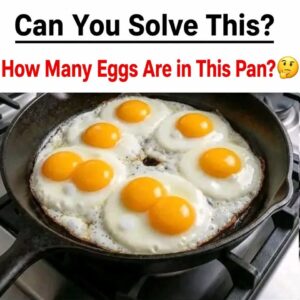
The picture contains several visible yolks, but the egg whites overlap in places. This makes it difficult to identify every individual egg. While counting the yolks may seem like the most obvious approach, it does not necessarily tell us how many eggs were cracked into the pan.
Why? Because some eggs naturally contain two yolks.
These unusual eggs are called double-yolk eggs. They occur when a hen releases two yolks close together, and both become enclosed within the same shell. When cracked into a pan, one egg can therefore produce two separate yolks surrounded by a shared mass of egg white.
That small detail changes the entire puzzle.
Looking at the Eggs Carefully
Start by examining the upper part of the pan. Two eggs appear to have single yolks. These are the easiest to identify because each yolk appears to sit within its own distinct portion of egg white.
Next, look toward the right side. Two more single-yolk eggs appear in this area. If each visible yolk belongs to a separate egg, the total so far is four eggs.
The real mystery lies on the left side and near the bottom of the pan.
In these areas, you can see two yolks surrounded by larger, connected-looking portions of egg white. At first glance, each area might look like one unusually shaped egg. However, the white portions could also represent two separate eggs whose whites spread into one another after they were cracked into the pan.
This creates two possible interpretations for each of the remaining areas.
- Possibility one: Each area contains one double-yolk egg.
- Possibility two: Each area contains two separate eggs whose whites have merged together.
Because both interpretations can produce a similar-looking result, the image alone may not provide enough evidence to distinguish between them.
Answer One: Six Eggs
The first possible answer is six eggs.
To reach this number, assume that the two yolks on the left belong to a single double-yolk egg. Make the same assumption about the two yolks near the bottom.
The count would then be:
- Two single-yolk eggs at the top.
- Two single-yolk eggs on the right.
- One double-yolk egg on the left.
- One double-yolk egg near the bottom.
That gives us six eggs altogether.
This interpretation works if both pairs of yolks came from double-yolk eggs. The larger white portions would each belong to one egg containing two yolks.
Although double-yolk eggs are less common than ordinary single-yolk eggs, they are perfectly possible. Therefore, six is a reasonable answer if the picture represents two such eggs.
Answer Two: Seven Eggs
The second possible answer is seven eggs.
For this interpretation, imagine that only one of the two unusual areas contains a double-yolk egg. The other area contains two separate eggs whose whites spread together during cooking.
For example, the left side could contain one double-yolk egg, while the bottom area could contain two separate eggs.
The calculation becomes:
- Four single-yolk eggs in the clearly identifiable areas.
- One double-yolk egg.
- Two additional single-yolk eggs whose whites have merged.
The result is seven eggs.
The opposite arrangement would produce the same total. The left side could contain two separate eggs, while the bottom area contains one double-yolk egg.
Without clearer boundaries around the whites, it is difficult to determine which arrangement, if either, reflects what actually happened.
Answer Three: Eight Eggs
The third possibility is eight eggs.
This answer assumes that every visible yolk came from a different egg. Under this interpretation, the two yolks on the left belong to two separate eggs, and the two yolks near the bottom also belong to two separate eggs.
Their whites simply spread together when the eggs were cracked into the hot pan.
The calculation is straightforward:
- Two eggs at the top.
- Two eggs on the right.
- Two eggs on the left.
- Two eggs near the bottom.
That makes eight eggs altogether.
This explanation is also plausible because raw egg whites spread easily across a flat cooking surface. When two eggs are cracked close together, their whites can run into one another and form a continuous shape.
As a result, two separate eggs may look like one large egg with two yolks.
So, Which Answer Is Correct?
The most important lesson is that counting visible yolks is not always the same as counting individual eggs.
If both unusual areas contain double-yolk eggs, the answer is six. If only one area contains a double-yolk egg, the answer is seven. If all eight yolks came from separate eggs, the answer is eight.
The picture, as described, does not establish which interpretation is correct. There is no clearly visible boundary that conclusively proves whether either pair of yolks came from one egg or two.
Therefore, six, seven, and eight are all possible answers, depending on the assumptions made about the merged egg whites and double-yolk eggs.
This is what makes the puzzle entertaining. It encourages you to look beyond the obvious details, consider alternative explanations, and recognize when the available evidence does not support one definitive conclusion.
Sometimes, the smartest response to a brain teaser is not to rush toward a single number. It is to understand why different answers might be possible.
Now it is your turn.
Look at the pan again and decide which interpretation seems most convincing. Would you choose six because you believe both pairs of yolks came from double-yolk eggs? Would you choose seven because only one pair appears to share an egg? Or would you choose eight because every yolk could belong to a separate egg?
Share your answer in the comments and explain your reasoning. The most interesting part of this puzzle is not simply the number you choose, but the details you notice that lead you to that conclusion.