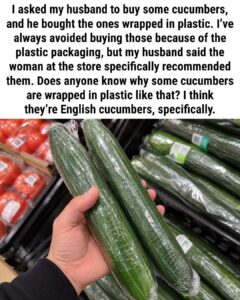
English cucumbers are easy to recognize in the produce section. They are long, slender, usually nearly seedless, and often sold tightly wrapped in a thin layer of plastic. While the packaging may seem unnecessary, especially when so much attention is being given to reducing plastic waste, there is a practical reason behind this common supermarket practice.
The answer comes down to moisture, freshness, transportation, and food waste. English cucumbers have a high water content and a relatively delicate skin, making them vulnerable to dehydration after harvesting. Their plastic wrapping acts as a protective barrier that slows moisture loss and helps preserve their crisp texture for longer.
But the story behind these wrapped cucumbers is more interesting than it first appears. The packaging involves a balance between preserving fresh food, managing supply chains, and reducing environmental impact.
1. English Cucumbers Lose Moisture Easily
Cucumbers contain approximately 95% water, which contributes to their refreshing taste and crisp texture. However, this high water content also makes them susceptible to losing moisture after they are harvested.
Once a cucumber is separated from the plant, it can no longer replace the water it loses. Moisture gradually escapes through its outer surface into the surrounding air, particularly when storage conditions are warm or dry.
As dehydration progresses, a cucumber may become softer, develop wrinkles, and lose some of its appealing firmness.
English cucumbers are often grown to have smooth, tender skin and are commonly sold without the thick, waxy appearance associated with some other varieties. Although this makes them convenient to prepare and eat, it also means that controlling moisture loss during storage can be especially important.
A thin plastic wrapper helps slow this process by creating a barrier between the cucumber’s surface and the surrounding air. When appropriately designed and applied, the packaging reduces water vapor loss and helps the cucumber remain firm and attractive.
2. The Plastic Wrapper Extends Shelf Life
One of the main reasons supermarkets sell English cucumbers wrapped in plastic is to help them remain marketable for longer.
Fresh produce travels through several stages before reaching a customer’s kitchen. After harvesting, cucumbers may be sorted, packed, transported to distribution centers, delivered to supermarkets, displayed on shelves, and finally carried home.
During this journey, they can spend considerable time outside the controlled conditions in which they were originally grown.
Without adequate protection, moisture loss can gradually reduce their quality. Plastic packaging helps slow dehydration, allowing cucumbers to retain their appearance and texture during storage and distribution.
The exact benefit depends on factors such as the type and thickness of the film, storage temperature, humidity, and the cucumber’s condition at harvest.
Packaging does not make cucumbers last indefinitely, and it cannot prevent every form of deterioration. Nevertheless, it can help extend their usable life compared with leaving them exposed to dry air.
For supermarkets, this can mean fewer cucumbers becoming shriveled or unsellable before customers purchase them.
For consumers, it may mean having more time to enjoy the vegetable before its quality declines.
3. Why English Cucumbers Are Wrapped More Often Than Other Varieties
Not every cucumber is sold in plastic. Shorter slicing cucumbers, pickling cucumbers, and some locally grown varieties are frequently sold loose or in other types of packaging.
English cucumbers, sometimes marketed as seedless or greenhouse cucumbers, are particularly associated with individual plastic wrapping because of their long shape, tender skin, and retail presentation.
Many are cultivated in greenhouses, where growing conditions can be carefully managed to produce long, straight cucumbers with consistent quality.
Their appearance is part of their appeal. Customers often expect them to have smooth skin, minimal blemishes, and a firm texture. The wrapper helps protect that appearance during handling and transport.
The packaging can also reduce direct contact with hands and surrounding surfaces. However, this should not be confused with sterilization or guaranteed protection against contamination.
Plastic wrapping is therefore primarily a preservation and handling measure, not proof that the cucumber is safer to eat than an unwrapped one.
4. Does the Plastic Keep Bacteria Away?
Plastic wrapping can provide a physical barrier against some sources of contamination after packaging, but it does not guarantee that the cucumber is clean or free from harmful microorganisms.
Contamination can occur at various points in the food supply chain, including during growing, harvesting, washing, packing, transportation, and retail handling.
Even produce that looks spotless can carry microorganisms that are invisible to the naked eye. Greenhouse cultivation does not eliminate this possibility.
The wrapper also cannot necessarily prevent contamination if the cucumber was contaminated before packaging or if the package is damaged or improperly handled.
For this reason, consumers should wash fresh cucumbers before cutting or eating them, whether they are wrapped or sold loose.
Remove and discard the plastic first. Rinse the cucumber thoroughly under cool running water, gently rubbing its surface with clean hands. Dry it with a clean paper towel or cloth before preparing it.
There is no need to use soap, detergent, or household disinfectants on fresh produce. These products are not intended for washing food and may leave unwanted residues.
If a cucumber has visible signs of spoilage, such as extensive soft areas, leaking liquid, or an unpleasant smell, washing will not restore its quality.
5. The Environmental Cost of Plastic Wrapping
Although plastic packaging offers practical advantages, it also creates environmental challenges.
Most individual cucumber wrappers are made from lightweight plastic film. These materials can be difficult to recycle through ordinary household recycling programs because thin films may tangle sorting machinery or require specialized collection systems.
The wrapper may appear small, but the impact becomes more significant when millions of cucumbers are packaged and sold.
Plastic production consumes resources, and discarded packaging can contribute to litter and environmental pollution when it is not properly managed.
This has led consumers, retailers, and food producers to question whether individually wrapping cucumbers is always necessary.
Some supermarkets have explored alternatives such as selling cucumbers loose, using different packaging materials, or reducing the amount of plastic used.
However, removing the wrapper involves a trade-off. If unwrapped cucumbers lose moisture more quickly and spoil before they are eaten, the resulting food waste also carries environmental costs.
Growing, transporting, refrigerating, and distributing food all require resources. When a cucumber is thrown away, the resources used to produce it are wasted as well.
The environmental comparison therefore depends on how much packaging is used, how effectively it preserves the produce, what happens to the packaging after use, and whether the alternative leads to additional food waste.
6. Does Less Packaging Always Mean Less Waste?
It is tempting to assume that an unwrapped cucumber is automatically the more environmentally friendly choice. In some situations, that may be true, but the answer is not always straightforward.
Plastic packaging creates waste, yet it can also reduce spoilage. The important question is whether the reduction in food waste justifies the environmental cost of the packaging in a particular supply chain.
For example, cucumbers that are sold and consumed quickly in a nearby market may need less protective packaging than those transported over long distances or stored for extended periods.
Temperature management and careful handling also make a difference. Even a wrapped cucumber may deteriorate quickly if it is stored under unsuitable conditions.
Packaging alternatives must therefore be evaluated on their actual performance, including their ability to preserve freshness, their material requirements, and the availability of suitable recycling or disposal systems.
There is no single solution that works equally well for every retailer, location, and distribution method.
7. How to Keep English Cucumbers Fresh at Home
Once you bring an English cucumber home, a few simple habits can help preserve its quality.
- Follow the storage guidance on the package. Cucumbers can be sensitive to excessively cold conditions, so avoid placing them in the coldest part of the refrigerator.
- Keep the cucumber dry. Excess surface moisture can encourage deterioration, particularly if the cucumber is stored in a sealed environment.
- Avoid unnecessary handling. Bruising and pressure can damage the tender skin.
- Keep it away from certain ripening fruits. Apples, bananas, and some other fruits release ethylene, which can contribute to quality changes in sensitive produce.
- Use it while it is fresh. Once sliced, cucumber has more exposed surface area and should be stored in a clean, covered container in the refrigerator.
Storage life varies with freshness at purchase and the conditions in your kitchen, so check the cucumber regularly rather than relying on a fixed number of days.
If you buy more than you can reasonably eat, choosing a smaller quantity may be the simplest way to reduce both food waste and unnecessary packaging.
The Bottom Line
English cucumbers are wrapped in plastic mainly because they lose moisture easily. The thin film helps slow dehydration, maintain firmness, protect their appearance during transport, and potentially reduce spoilage before they reach consumers.
However, the wrapper is not a substitute for washing, does not guarantee food safety, and contributes to plastic waste.
The most sensible approach is to recognize both sides of the issue: packaging can help preserve fresh food, but its environmental benefits must be weighed against the impact of the material itself.
Ultimately, the humble cucumber wrapper illustrates a larger challenge in modern food production: finding ways to deliver fresh, nutritious food while minimizing waste and environmental harm. The best solution is not necessarily to use the most packaging or the least packaging, but to use an appropriate amount while ensuring that more of the food we grow actually gets eaten.