Have you ever looked at a simple picture and discovered that the answer was completely different from what you first imagined? Some brain teasers are designed to challenge our assumptions, encourage careful observation, and make us think twice before reaching a conclusion.
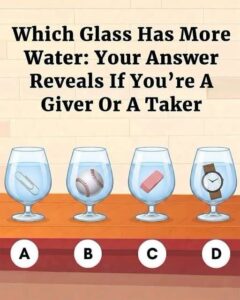
One popular puzzle asks a deceptively simple question: Which glass contains the most water?
Imagine four identical glasses, each filled to the same visible water level. However, every glass contains a different object. Glass A holds a paperclip, Glass B contains an eraser, Glass C has a wristwatch, and Glass D contains a baseball.
At first glance, all four glasses appear to contain the same amount of water. But there’s an important detail that changes everything.
The objects inside the glasses occupy space, meaning the amount of water in each glass isn’t necessarily equal.
Take a moment to consider the four options. Would you choose the glass with the smallest object, the largest object, or something in between?
The answer may seem obvious once you understand the science behind it, but the reasoning offers an interesting reminder about the importance of looking beyond appearances.
The Answer Is Glass A
The correct answer is Glass A, the one containing the paperclip, assuming all four glasses are identical, the water levels are equal, and each object is fully submerged.
The explanation comes from a scientific principle called water displacement.
Whenever an object is placed in water, it occupies space that the water cannot occupy. If the water level is kept at the same height in several identical glasses, the glass containing the object that takes up the least space will contain the greatest volume of water.
A paperclip occupies very little space compared with an eraser, wristwatch, or baseball. Consequently, it displaces less water than the other objects.
That leaves more room for water inside Glass A.
The baseball, on the other hand, occupies considerably more space. Because the water level is the same, less water can fit inside the glass containing the baseball.
This is why the glasses can appear equally full while actually containing different amounts of water.
Why Water Displacement Matters
Water displacement is a basic scientific concept used in many everyday situations.
When you place ice cubes in a glass of water, the cubes occupy space within the glass. When you put a stone into a container of water, the water level rises because the stone takes up room that was previously available to the liquid.
The same principle helps explain why objects of different sizes affect how much water a container can hold.
In this puzzle, the glasses are identical, and their water levels are equal. The only important difference is the space occupied by each object.
For fully submerged objects, the relationship can be expressed simply:
Water volume = Volume below the waterline − Volume occupied by the submerged object.
Therefore, when the total volume below the waterline remains constant, a smaller submerged object means a greater volume of water.
There is one important detail: the objects must be fully submerged for the comparison to work in this straightforward way. If an object floats or extends above the water, its displacement depends on how much of its volume is submerged, rather than simply its overall size.
For the puzzle as described, the paperclip occupies the least space, making Glass A the winner.
Why Equal Water Levels Can Be Misleading
Our eyes often encourage us to make quick judgments.
When we see four glasses filled to the same height, we naturally assume they contain equal amounts of water. In many everyday situations, that assumption might seem reasonable.
However, the objects inside the glasses change the situation.
The waterline tells us how high the liquid reaches, but it doesn’t tell us how much liquid is actually present. To determine the volume accurately, we must also consider how much space is occupied by the objects inside.
This is a simple example of how appearances can hide important information.
Similar mistakes can happen in other situations, too. Two boxes might look identical from the outside but contain different amounts of material. Two rooms might have the same floor area but offer different amounts of usable space. Two containers might reach the same fill line while holding different quantities of liquid.
The lesson is not that appearances are always deceptive. Rather, appearances sometimes provide only part of the information we need.
Can Your Answer Reveal Your Personality?
Some versions of this puzzle claim that the glass you choose reveals whether you’re generous, selfish, thoughtful, practical, or emotionally intelligent.
It’s an intriguing idea, especially because personality quizzes are popular online. People enjoy answering questions that promise to reveal something about their character.
But there is an important distinction between an entertaining personality game and a scientifically supported assessment.
Choosing a particular glass cannot reliably determine whether someone is a giver or a taker.
Your answer is more likely to reflect how you interpreted the puzzle, whether you recognized the principle of water displacement, and how carefully you considered the objects inside the glasses.
Someone who chooses Glass A may understand the science immediately. Another person may initially choose the baseball because it appears to take up more space. Neither answer, by itself, reveals whether that person is kind, generous, or selfish.
Personality is far more complex than a single decision in a brain teaser.
Our character becomes clearer through repeated behaviors, the way we respond to challenges, and how we treat people over time.
What Does Being a Giver Really Mean?
Although the puzzle cannot diagnose personality, it provides an opportunity to think about generosity.
A giver is often someone who willingly offers time, attention, encouragement, or practical assistance to others. These actions don’t always involve money or material gifts.
A friend who listens patiently when someone is struggling may be showing generosity. A colleague who helps a new employee learn a difficult task may be doing the same. A family member who checks in on someone going through a difficult period can offer support that makes a meaningful difference.
These actions are often more revealing than answers to hypothetical questions.
At the same time, being generous doesn’t mean agreeing to every request or putting everyone else’s needs ahead of your own.
Healthy generosity includes boundaries. People can care deeply about others while still protecting their time, energy, finances, and emotional well-being.
Accepting help also doesn’t make someone selfish. Relationships work best when people can give and receive support without feeling that every interaction must be perfectly balanced.
The goal isn’t to become someone who always gives and never receives. It’s to develop relationships built on mutual respect, compassion, and trust.
Why We Should Question Our First Impressions
The most valuable part of this puzzle may be the reminder to pause before deciding that we understand a situation.
Our brains constantly make quick judgments. This ability helps us navigate daily life, but it can also cause us to overlook details that change the answer.
When you encounter a challenging question, consider asking yourself three things:
- What am I assuming? You might be treating equal water levels as proof that the glasses contain equal amounts of liquid.
- What information am I overlooking? The objects inside the glasses occupy space that could otherwise hold water.
- What evidence supports my conclusion? Applying the principle of water displacement provides a logical explanation for the answer.
This approach works beyond puzzles. When facing a disagreement, making a decision, or evaluating unfamiliar information, examining the underlying facts can help prevent misunderstandings.
Sometimes, the right answer becomes clear only after we recognize the assumption that led us in the wrong direction.
Try This Puzzle With Friends and Family
One reason simple brain teasers remain popular is that they are easy to share.
Ask a friend which glass contains the most water without revealing the answer. Give everyone a few seconds to think independently before discussing their choices.
You may be surprised by how many different explanations emerge.
Some people will focus on the height of the water. Others will consider the size of the objects. Someone may remember a science lesson and identify the correct answer immediately.
Once the explanation is revealed, the puzzle becomes an opportunity to discuss how different people approach the same problem.
You can even recreate the experiment at home using four identical transparent containers, water, and several small objects that can be safely submerged. Fill each container to the same level, add the objects, and measure the amount of water needed to reach that level under controlled conditions.
Be sure to use objects that won’t contaminate the water or damage the containers.
Seeing the principle in action can make the answer much easier to understand than simply reading an explanation.
The Final Lesson: Look Beyond the Surface
Glass A holds the most water because the paperclip occupies less space than the other fully submerged objects.
It’s a straightforward scientific answer, but the reasoning behind it demonstrates something important: the most obvious interpretation isn’t always the most accurate one.
Still, there’s no need to turn a simple puzzle into a judgment about someone’s character. Your choice doesn’t determine whether you’re generous, selfish, intelligent, or thoughtful.
Those qualities are better understood through your actions, your decisions, and the way you treat other people over time.
Perhaps that’s the most useful takeaway from this little challenge. Be curious enough to examine the details, thoughtful enough to question assumptions, and compassionate enough to recognize that people are more complicated than a single answer.