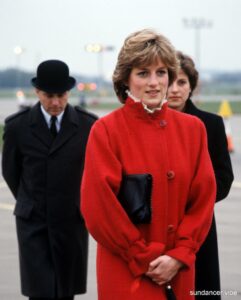
In 1981, the world watched what seemed like the beginning of a modern fairytale. Princess Diana—young, reserved, and instantly adored—stepped into a life defined by tradition, scrutiny, and immense public fascination. Her engagement to Prince Charles captivated millions, creating an image of romance and destiny that felt almost untouchable.
At just nineteen years old, Diana found herself at the center of global attention. Every glance, every gesture, every silence was interpreted and amplified. The wedding that followed in July 1981 became one of the most watched events in history, framed as a symbol of renewal for the monarchy—a union that promised stability and hope.
But behind the spectacle, something far more complicated was unfolding.
A Moment the World Misunderstood
One of the most enduring images from that period came months before the wedding. In March 1981, Diana stood at an airport saying goodbye to Charles as he departed for a royal tour. She wore a red coat, her expression visibly emotional, her eyes filled with tears.
At the time, the interpretation seemed simple. The public saw a young woman in love, overwhelmed by a temporary separation from the man she was about to marry. Media coverage emphasized tenderness—Charles’s attempt to comfort her, the affectionate farewell, the emotional depth of the moment.
It fit perfectly into the fairytale narrative.
But the truth behind those tears would remain hidden for years.
What Was Really Happening
Decades later, through recordings revealed in Diana: In Her Own Words, a different story emerged—one far more painful and complex.
According to Diana’s own account, the tears captured that day were not simply about saying goodbye. They came after a deeply unsettling realization.
Shortly before Charles left, Diana became aware of his continued emotional connection with Camilla Parker Bowles.
It wasn’t a dramatic confrontation. There was no public argument or visible conflict. Instead, the realization came quietly—through a moment that, on the surface, might have seemed ordinary.
A phone call.
Diana described being present when Camilla contacted Charles. The tone, the familiarity, the unspoken intimacy of the exchange made something clear to her in a way she could no longer ignore. Faced with the situation, she chose to leave the room rather than create tension.
But that decision carried emotional weight.
In that moment, the fairytale shifted.
A Growing Awareness
What Diana experienced was not just jealousy or insecurity—it was the dawning awareness that her relationship was not as straightforward as it had appeared. The emotional space she believed she shared exclusively with Charles was, in reality, more complicated.
This realization didn’t come with clarity or resolution. It came with uncertainty.
And it didn’t end there.
During Charles’s absence, Diana discovered something that deepened her distress: a bracelet that had been prepared as a gift for Camilla. It wasn’t just the object itself—it was what it symbolized. Thought, intention, and emotional investment directed elsewhere.
For Diana, it confirmed what she had begun to suspect.
The Collapse of a Narrative
Up until that point, the public story had been one of perfect alignment—two people brought together by destiny, preparing to begin a life under the world’s gaze.
But privately, Diana was beginning to question that narrative.
She later spoke about the confusion and hurt she felt, wondering why she had not been given the full truth before stepping into such a significant commitment. The contrast between expectation and reality became increasingly difficult to ignore.
Even seemingly ordinary interactions took on new meaning.
A lunch with Camilla—something that might have appeared polite and routine from the outside—felt layered with tension for Diana. Subtle comments and quiet dynamics reinforced the sense that she was navigating a relationship that had existing complexities long before her arrival.
For someone so young, and so new to that world, the emotional impact was profound.
The Weight of Expectation
Despite her growing doubts, Diana continued forward. The momentum surrounding the engagement was immense. Public expectation, institutional pressure, and the sheer scale of the event made stepping away nearly impossible.
The fairytale had already been written in the public imagination.
In later reflections, Diana would describe the relationship as emotionally unstable and difficult to navigate. Her now-famous remark—“there were three of us in this marriage”—did not emerge suddenly. It reflected something she had sensed from the very beginning.
Even before the wedding, the imbalance was there.
Looking Back at the Airport Scene
With the benefit of hindsight, that airport moment takes on an entirely different meaning.
What the world saw as romantic vulnerability was, in reality, emotional overwhelm. The tears were not just about separation—they were about realization, confusion, and the weight of something unspoken.
It was a turning point.
Not a public one, but a deeply personal one.
Biographers and historians have since pointed to that moment as an early indication of the challenges that would define Diana’s marriage. It marked the point where perception and reality began to diverge in a way that could not be easily reconciled.
A Story Beyond the Image
What makes this moment so powerful is the contrast it represents.
On one side: a carefully constructed public image of love, unity, and royal tradition.
On the other: a private experience shaped by doubt, complexity, and emotional uncertainty.
That gap—between what was seen and what was felt—became one of the defining elements of Diana’s story.
It is also what continues to resonate.
A Lasting Perspective
Today, those images from 1981 are viewed through a different lens. They are no longer just symbols of romance or nostalgia—they are reminders of how incomplete a single moment can be when removed from its context.
Diana’s story is often remembered for its public chapters, but it is these quieter, more personal moments that offer deeper understanding.
The airport goodbye was not just a farewell.
It was a realization.
A moment when the illusion began to shift, revealing a reality far more complicated than anyone watching could have known.