Monkeys Test Narcissism: What Your Eyes Notice Might Surprise You
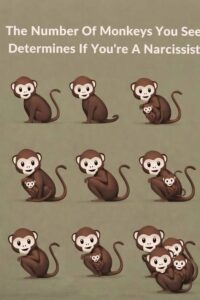
At first glance, the image looks like a simple collection of cartoon monkeys arranged in a playful pattern. But then you notice the bold caption: “The number of monkeys you see determines if you’re a narcissist.”
Suddenly, a harmless picture becomes a challenge. You start counting the obvious monkeys, looking at their faces, and examining the spaces between them. Then you look again, wondering whether some smaller figures are hiding inside larger shapes.
How many monkeys can you see?
Some people spot only a handful at first. Others discover additional faces and figures after studying the image more carefully. Before long, the simple puzzle becomes a conversation starter, with friends comparing answers and wondering what their results might reveal about their personalities.
But does the number of monkeys you see really say anything about whether you are a narcissist?
The short answer is no. There is no scientific evidence that counting monkeys in a picture can diagnose narcissism or reliably measure this personality trait.
Still, the puzzle offers an interesting opportunity to explore how our brains interpret visual information, why people notice different details, and why online personality tests can feel surprisingly convincing.
Why Do People See Different Numbers of Monkeys?
Human vision is not simply a camera recording everything in front of us. Our brains actively organize the information received through our eyes, identifying shapes, separating objects from backgrounds, and deciding which details deserve our attention.
When you look at a complicated picture, your brain tries to make sense of the overall scene. You might recognize the largest monkey faces immediately while overlooking smaller figures formed by overlapping outlines or unusual arrangements.
Someone else might approach the same image differently, concentrating on individual shapes rather than the overall composition.
Several factors can influence what you notice.
1. Attention to detail
Some viewers instinctively examine small features, searching for hidden shapes or unusual patterns. Others identify the main figures quickly and move on without examining every corner.
This difference can affect how many monkeys someone counts, but it does not establish that one person has a particular personality type.
2. Visual perception
The brain often organizes visual information into meaningful groups. Shapes that overlap or share outlines can make it difficult to determine where one figure ends and another begins.
As a result, two people can look at the same picture and interpret some of its features differently.
3. Expectations and first impressions
If you expect to see a small number of monkeys, you may initially focus on the most obvious figures. If someone tells you there are many hidden monkeys, you might begin searching more carefully and notice shapes that previously escaped your attention.
Your expectations can influence what you look for, although they do not necessarily determine what you will see.
4. Time spent examining the image
A quick glance and a detailed examination are two different experiences. The longer you study a complex image, the more opportunities you have to notice overlooked features.
That is one reason people sometimes change their answers after looking at a picture for a second or third time.
None of these observations, by itself, provides a reliable measure of narcissism.
What Is Narcissism, Really?
Narcissism is often discussed online as though it simply means being selfish, arrogant, or overly interested in appearance. In reality, the concept is more complicated.
In everyday conversation, narcissistic traits may refer to behaviors such as excessive self-importance, a strong desire for admiration, or difficulty considering other people’s perspectives.
These traits exist in different degrees, and displaying one occasionally does not automatically make someone a narcissist.
Psychologists also distinguish between narcissistic traits and narcissistic personality disorder, a recognized mental health diagnosis involving persistent patterns of functioning that can cause significant difficulties in a person’s life and relationships.
A diagnosis cannot be made by counting objects in an illustration, choosing an answer in a social media quiz, or deciding that someone’s behavior matches a few descriptions online.
Professional assessment considers broader patterns, personal history, and relevant diagnostic criteria.
This distinction matters because casually labeling people can create misunderstandings and encourage unfair judgments about their character.
Why Do These Viral Personality Tests Feel So Accurate?
Picture puzzles and personality quizzes spread rapidly online because they combine curiosity with a promise of self-discovery.
People naturally want to understand themselves. We wonder whether we are observant, creative, empathetic, confident, or different from those around us.
A quiz that promises to reveal something hidden about our personalities can be difficult to resist.
There are several reasons these challenges attract attention.
-
They are easy to participate in. You don’t need special knowledge or equipment. You simply look at an image and choose an answer.
-
They create a sense of mystery. The possibility of discovering something hidden encourages people to look again.
-
They invite comparison. Friends and family members can share their answers and discuss their differences.
-
They encourage self-reflection. Even an unscientific quiz can prompt someone to think about how they perceive themselves.
Another psychological concept helps explain why broad personality descriptions sometimes feel remarkably personal: the Barnum effect. This refers to the tendency to perceive general statements about personality as uniquely accurate descriptions of ourselves.
For example, a quiz might suggest that you sometimes enjoy attention but also value privacy. Many people could identify with that statement, even though it reveals very little about their individual personality.
When a quiz combines a surprising visual puzzle with a confident personality claim, it can feel meaningful even when the connection has not been scientifically established.
Does Seeing More Monkeys Mean You Are More Observant?
Not necessarily.
If one person identifies more figures than another, that could reflect differences in attention, familiarity with visual puzzles, interpretation of overlapping shapes, or simply the way the image was designed.
It would be a mistake to conclude that the person who sees the most monkeys is more intelligent, more analytical, or more narcissistic.
Likewise, someone who spots only a few figures is not necessarily less observant.
A single puzzle captures only a brief moment of visual processing. It cannot account for the many different ways people pay attention, solve problems, and interpret information across everyday situations.
To understand a person’s abilities or personality, much more meaningful evidence would be needed than a number produced by a viral image.
Try the Challenge for Yourself
If you have the image in front of you, take a moment to examine it without worrying about what your answer supposedly means.
-
First, count the most obvious monkey faces.
-
Next, look at the outlines and overlapping shapes.
-
Examine the smaller spaces between the larger figures.
-
Count again and see whether your answer changes.
You may discover figures you missed the first time. You might also disagree with someone else’s interpretation of a particular shape.
That is part of the fun.
Just remember that different answers do not automatically indicate different personality traits. Without a clearly defined image, a consistent counting method, and validated psychological research, the result is simply a visual puzzle rather than a personality assessment.
The Real Lesson Behind the Monkey Picture
The appeal of the monkey challenge is not that it can expose a hidden psychological condition. It is that it encourages us to look twice at something we initially believe we understand.
We often make quick judgments based on limited information, whether we are interpreting a picture, forming an opinion about a stranger, or deciding what someone’s behavior means.
Taking a closer look can help us recognize that our first impression may not tell the whole story.
The same principle applies to personality. A person cannot be fully understood through one habit, one photograph, one quiz result, or one moment of behavior.
So, how many monkeys did you see? Enjoy comparing your answer with others, but don’t let a viral caption determine what you think about yourself or anyone else.
The number might make for an entertaining conversation, but it cannot tell you whether you are a narcissist. Understanding personality requires far more than counting cartoon faces.