I flung open the front door barefoot, and the cold hit me like a slap.
He was still standing there under the porch light, roller dripping black paint onto the driveway. My father. Seventy-three years old, wearing a hoodie I had bought him for Christmas, two miles from the apartment where he was supposed to be asleep.
“Dad?” I whispered.
He turned and gave me the same easy smile he used to give me when I was little and caught him sneaking cookies before dinner.
“Hey, kiddo,” he said. “Go back to bed. I’m almost finished.”
Then he dipped the roller again and said the words that made my knees give out.
“Your mother hates it when this door is white. I have to fix it before she wakes up.”
My mother had been dead for nine years.
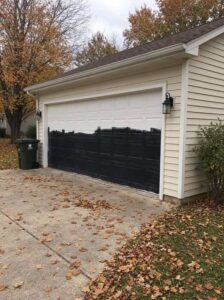
For three weeks, someone had been painting our garage door black.
Every morning, my husband, Daniel, and I woke to find another thick coat of paint covering the white door. At first, we thought it was a neighborhood prank. We installed a security camera, replaced the locks, and even called the police.
But whoever was doing it always came after midnight.
The camera never seemed to catch a clear face. The figure wore a hood, kept his head down, and left before dawn. All we could see was a shadow moving steadily back and forth with a paint roller.
Daniel thought it was someone who hated us.
I wondered whether we had unknowingly offended a neighbor.
Neither of us imagined that the person ruining our garage door was my own father.
“Dad, what are you doing here?” I asked, stepping onto the freezing driveway.
He looked at the garage as if I had asked him why the sky was blue.
“Your mother picked this color,” he said. “You know how she gets when things aren’t done her way.”
My throat tightened.
“Mom isn’t here anymore.”
His smile disappeared.
For a moment, he stared at me with an expression I had never seen before, as though he were trying to recognize a stranger standing in front of him.
Then he looked back at the door.
“Don’t be silly,” he muttered. “She’s inside.”
I reached for the roller, but he pulled it away.
“Please, sweetheart. I promised her.”
That was when Daniel appeared behind me, wrapped in his dressing gown. He took one look at my father and quietly called his name.
Dad ignored him.
Instead, he leaned toward me and whispered, “She gets frightened when the door is white. That’s why I have to come every night.”
I began to cry.
Daniel gently took the roller from his hand. This time, Dad didn’t resist. He simply stood there, staring at the black paint dripping onto his shoes.
We brought him inside, made him coffee, and sat with him until the sun came up.
He couldn’t explain how he had left his apartment without anyone noticing. He couldn’t remember the date. And when I asked him about my mother, he described the blue dress she had worn on their wedding day as though he had seen her yesterday.
By morning, I understood that this wasn’t a prank or a grudge.
Something was happening to my father.
We took him to the doctor that afternoon. After several examinations, the doctor explained that Dad was experiencing significant memory problems and needed further assessment for a possible neurological condition. We were warned not to assume a diagnosis immediately, but his confusion, nighttime wandering, and difficulty distinguishing the past from the present were serious concerns.
I held his hand while the doctor spoke.
Dad stared at the floor.
“I didn’t mean to frighten her,” he said quietly.
I squeezed his fingers.
“You didn’t frighten me, Dad.”
But I couldn’t stop thinking about the garage door.
Why black?
Why every night?
And why was he so certain my mother was waiting inside?
The answer came three days later, when I visited his apartment to help organize his medication and arrange safer nighttime supervision.
In the bottom drawer of his bedside table, I found a small, yellowed photograph.
It showed my parents standing outside their first house, smiling beneath a bright summer sky. My mother wore the blue dress Dad had mentioned. Behind them was a white garage door.
Someone had drawn a thick black line across it with a marker.
On the back, in my father’s handwriting, were seven words:
The night she died, the door was white.
I sat on the edge of his bed, reading the sentence again and again.
Then I remembered.
Nine years earlier, my mother had suffered a sudden medical emergency at home. Dad had called for an ambulance, but the driveway was blocked by a delivery van. He had tried to guide the driver away, shouting and waving his arms, while my mother lay inside struggling to breathe.
The ambulance eventually reached the house, but it was too late.
For years, Dad blamed himself for not getting help to her sooner. He never spoke much about that night. Whenever I asked, he changed the subject or told me there was nothing left to discuss.
Now, as his memory began to fail, he seemed to be trapped inside the worst moment of his life.
I called him that evening and gently asked why he had marked the photograph.
There was a long silence.
Then he said, “Your mother wanted the garage door painted black. She said it would be easier to see at night.”
“Dad, was it really black?”
“I don’t remember.”
His voice broke.
“I just remember standing outside, waiting for the ambulance. I kept thinking that if the door had been a different color, someone might have found us sooner.”
I closed my eyes.
The black paint wasn’t anger. It wasn’t revenge. It was an old man’s desperate attempt to rewrite a night he had never forgiven himself for surviving.
Every evening, his mind returned him to that driveway. Every night, he tried to correct something he believed he had failed to do.
And every morning, he forgot that he had already tried.
We arranged for Dad to stay with us temporarily while we worked with his doctor and social worker to put proper support in place. We added door alarms, improved the outdoor lighting, and made sure someone could check on him overnight. Daniel took time off work, and I learned how to help my father through moments when the past felt more real to him than the present.
We also repainted our garage door white.
Not because the color mattered, but because I wanted Dad to see that he no longer needed to fix it alone.
The first evening he noticed the fresh paint, he stood beside me for a long time.
“Your mother liked this door,” he said.
“She did,” I answered.
He nodded slowly.
“Then we should keep it nice for her.”
I leaned against his shoulder.
“We will, Dad. I promise.”
He didn’t remember painting it black. He didn’t remember the police visits, the security cameras, or the night I found him outside. Those memories had already slipped away.
But when I took his hand, he held it tightly.
For a moment, he looked directly into my eyes and recognized me.
“My little girl,” he whispered.
I rested my head against his chest and listened to his heartbeat.
The next morning, the garage door was still white.
And for the first time in three weeks, nobody had come outside in the middle of the night to paint it.
I used to believe the scariest thing about losing someone was the moment they died.
Now I understand that sometimes grief continues long after death, quietly reshaping the people left behind.
Sometimes it hides inside old photographs, forgotten promises, and memories that refuse to stay buried.
And sometimes, it stands beneath your porch light with a paint roller in its hand, trying desperately to make yesterday turn out differently.
My father couldn’t bring my mother back.
But I could make sure he didn’t have to face his memories alone.
And that, I realized, was a promise worth keeping.