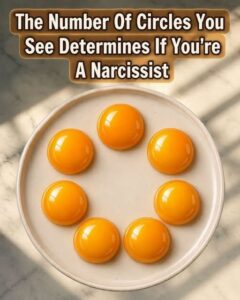
At first glance, this picture seems almost too simple to be a puzzle. Seven golden egg yolks sit neatly arranged on a plate, forming an attractive circular pattern. There are no complicated shapes, confusing colors, or hidden objects that immediately demand your attention.
So, how difficult could it possibly be to count the circles?
You might look at the picture, count the seven yolks, and feel confident that you have solved the challenge in just a few seconds.
But wait!
Before you settle on your answer, take another look. The question isn’t simply how many egg yolks are visible. It asks how many circles you can find in the picture.
And that small difference in wording is what makes this seemingly straightforward puzzle more interesting than it first appears.
Are the seven egg yolks the only circles you should count? Should the plate be included, too? What about the empty space in the middle of the arrangement?
Suddenly, a simple counting exercise becomes a challenge that encourages you to slow down, examine the details, and think carefully about what the question actually means.
The First Answer: Seven Circles
The most obvious answer is seven.
Each golden egg yolk forms a rounded shape, and the yolks are the main objects featured in the picture. If the puzzle asks you to count only the yolks, the solution is straightforward.
Start at the top and move clockwise around the arrangement, counting each yolk individually. Once you reach the final one, you should have counted seven.
This approach is simple and reliable because it focuses on the objects that immediately stand out.
However, there’s a small complication.
The question asks about circles in the picture, not specifically about egg yolks.
That distinction leaves room for another interpretation.
The Plate Changes the Count
If you include the outer circular outline of the plate, the total becomes eight.

7 circles
Count only the seven visible egg yolks.

8 circles
Count the seven yolks and the plate’s outer circular boundary.
Both answers can make sense, depending on the intended rules.
Someone counting only the individual food items might confidently answer seven. Another person who includes every clearly visible circular object might answer eight.
Neither person necessarily made a counting mistake. They may simply have interpreted the question differently.
This is precisely what makes the puzzle entertaining: the challenge isn’t only about counting accurately. It’s also about deciding what qualifies as a circle.
What About the Empty Space in the Middle?
Here’s where things become even more interesting.
Because the seven yolks are arranged in a circular pattern, they may create an open area in the center. Some viewers might wonder whether that empty space should count as another circle.
The answer depends on the precise shapes shown in the image.
An empty region isn’t automatically a circle simply because it appears between rounded objects. To count it as a circle, its boundary would need to form a clearly identifiable circular outline.
If the yolks are spaced evenly around the plate, the central gap might look roughly circular. But a roughly circular space isn’t necessarily a perfect circle, and the image’s exact geometry matters.
This distinction highlights an important principle in visual puzzles: a shape that seems circular at first glance isn’t always a clearly defined circle.
It’s worth examining the image carefully before adding the central space to your total.
Why Do People Get Different Answers?
You might expect everyone to arrive at the same answer when looking at such a simple picture. Yet people often disagree about visual puzzles because they approach the task with different assumptions.
One person may count only the main objects. Another may include the plate. Someone else might count every visible outline or interpret the question as an invitation to identify geometric shapes.
Our brains also tend to recognize patterns quickly.
When we see seven similar objects arranged together, we often perceive the arrangement as a whole before deliberately counting each item. That ability helps us understand everyday scenes quickly, but it can also encourage us to overlook details when precision matters.
The wording of the question plays an important role, too. If a puzzle doesn’t specify whether to count objects, outlines, or enclosed spaces, more than one interpretation may be reasonable.
That doesn’t make the puzzle pointless. In fact, discussing the different answers can be part of the fun.
Try This Simple Counting Strategy
Before revealing your answer to anyone else, try this method.
-
Count the yolks first. Start at the top and move clockwise, counting each yolk once.
-
Examine the outside edge. Decide whether the plate’s outline qualifies as an additional circle.
-
Inspect the center. Look for a clearly defined circular boundary rather than assuming the empty space counts.
-
Check your interpretation. Decide whether you’re counting objects, outlines, or all identifiable circular shapes.
-
Count once more. Make sure you haven’t counted the same object twice.
This approach helps separate the act of counting from the decision about what should be included.
It also makes it easier to explain your answer to someone who sees the picture differently.
What This Puzzle Says About Observation
Spot-the-difference games, visual counting challenges, and optical puzzles are popular because they turn ordinary images into small mental challenges.
They encourage us to pause, look more carefully, and question our first impressions.
They can also be enjoyable social activities. Families can compare answers, friends can challenge one another, and children can practice counting and recognizing shapes.
However, a single puzzle cannot reliably measure intelligence, personality, or overall observation skills. Someone who answers differently may simply be following a different interpretation of the instructions.
The real value lies in paying attention and enjoying the process of figuring out the answer.
So, What’s the Correct Answer?
Based on the description of the picture, the clearest answers are:
-
7 circles if you count only the egg yolks.
-
8 circles if you count the seven yolks plus the plate’s outer circular boundary.
Additional circles should only be included if the actual image contains clearly defined circular outlines that meet the puzzle’s intended rules.
Because the picture itself isn’t included here, it’s not possible to verify whether any other visible details should count.
Now it’s your turn! Did you answer seven or eight? Take another look, decide what counts as a circle, and challenge a friend to see whether they reach the same conclusion.