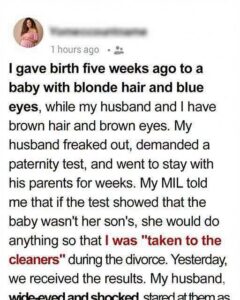
Five weeks after giving birth to our daughter, Isla, I thought the hardest part of motherhood would be surviving sleepless nights, learning her cries, and figuring out how to care for a tiny human who depended on me for everything.
I was wrong.
The hardest part turned out to be watching my husband look at our newborn daughter as though she were evidence of my betrayal.
Isla had beautiful blonde hair and bright blue eyes. Her little cheeks were round, her fingers curled around mine whenever I held her, and sometimes she stared up at me with an expression so serious that I couldn’t help laughing.
I thought she was perfect.
My husband, Rowan, thought something was wrong.
Both of us had brown hair and brown eyes. Neither of us expected our daughter to look so different from us. At first, Rowan joked that Isla must have inherited some distant relative’s features.
But the jokes stopped.
One evening, I was sitting on the sofa with Isla asleep against my chest when Rowan came over and stared at her.
He didn’t smile.
He didn’t reach out to touch her tiny hand.
Instead, he asked the question that changed everything.
“Are you sure she’s mine?”
For a moment, I thought I had misunderstood him.
“What?”
“Look at her, Emma. Neither of us has blonde hair or blue eyes. How am I supposed to believe this is normal?”
I felt as though someone had punched the air from my lungs.
“She’s five weeks old, Rowan. She’s your daughter.”
“Then you shouldn’t have a problem with a DNA test.”
I stared at the man I had married, desperately searching his face for some sign that he was frightened, confused, or simply speaking without thinking.
But he looked convinced that I was hiding something.
I had just given birth. My body was still recovering, I was barely sleeping, and I was trying to adjust to an entirely new life. The last thing I expected was to defend my fidelity to the person who had promised to stand beside me.
“Fine,” I finally whispered. “We’ll get the test.”
I agreed because I wanted the accusations to end. I wanted Rowan to look at Isla and see his daughter again.
I had no idea that agreeing to the test would only begin the most painful weeks of my marriage.
The Night My Husband Left
Rowan ordered a DNA test the following morning.
He barely spoke to me while we waited for the appointment. Every time I asked whether he wanted to hold Isla, he found a reason to leave the room.
When the samples had been collected, I thought the worst was behind us.
Instead, Rowan packed a bag.
“Where are you going?” I asked, standing in our bedroom doorway with Isla in my arms.
“I need some space.”
“Space from what? Your wife? Your daughter?”
“Don’t make this harder than it already is, Emma.”
He zipped his bag and walked past me.
I followed him downstairs, tears running down my face.
“You’re leaving me five weeks after I gave birth because our baby doesn’t look the way you expected?”
He stopped near the front door.
“I’m not saying I won’t come back. I just need to think.”
Then he left.
I stood there listening to his car disappear down the street while Isla began crying against my chest.
I carried her back upstairs, fed her, and rocked her until she fell asleep.
Then I sat on the nursery floor and cried too.
I didn’t cry because I was afraid of a DNA test. I knew I had never been unfaithful to Rowan.
I cried because the person who should have been helping me through the most vulnerable period of my life had decided I was guilty before he had any evidence.
His Mother’s Call Made Everything Worse
Two days later, Rowan’s mother, Barbara, called me.
I had hoped she might offer support. She knew how difficult the first weeks with a newborn could be, and I thought she might persuade her son to come home.
Instead, she asked whether I had anything to confess.
“Barbara, I have never cheated on Rowan.”
“Then you shouldn’t be worried about the results.”
“I’m not worried about the results. I’m worried about my marriage.”
She sighed impatiently.
“Rowan deserves to know the truth. If that child isn’t his, he needs to divorce you and move on.”
I tightened my grip on the phone.
“Isla is his daughter.”
“Then the test will prove it.”
She ended the call before I could respond.
I sat at the kitchen table, staring at the wall.
I had imagined my first weeks as a mother filled with photographs, visits from family, and conversations about Isla’s future. Instead, I was measuring each day by how many times I cried when nobody was watching.
My friends offered to visit, but I often told them I was fine because I didn’t want to explain what was happening.
Eventually, my older sister, Natalie, came over without asking permission.
She found me sitting beside Isla’s crib, staring at my sleeping daughter.
“You don’t have to pretend with me,” she said.
That was all it took.
I broke down.
Natalie held me while I told her everything. When I finished, she looked at Isla and gently brushed a finger across the baby’s tiny hand.
“Look at her, Emma. She’s a baby. She’s not responsible for anyone’s fears.”
I nodded, but I couldn’t stop worrying about what would happen when Rowan returned.
Would he apologize?
Would he believe the results?
And even if he did, would I ever forget how quickly he had decided I was capable of betraying him?
The Envelope Arrives
The results arrived on a Thursday morning.
I remember the day because the sky was gray, and Isla had spent most of the night waking every hour.
I was changing her when my phone rang.
It was Rowan.
“The results are here,” he said.
My heart began racing.
“Okay.”
“I’ll come over tonight.”
He sounded different. His voice was quieter than usual, but I couldn’t tell whether he was nervous or simply tired.
That afternoon seemed to last forever.
I fed Isla, changed her clothes, and tried to keep myself occupied. Every few minutes, I glanced toward the front window.
When Rowan finally arrived, he looked as though he hadn’t slept properly in days.
He stood in the doorway holding a sealed envelope.
For several seconds, neither of us spoke.
Then he walked into the living room and sat down.
I settled Isla in her bassinet beside the sofa.
“Open it,” I said.
Rowan stared at the envelope.
“You first.”
“No. You wanted this test. You should read the results.”
His fingers trembled slightly as he tore open the paper.
He pulled out the report and began reading.
At first, his expression didn’t change.
Then he read the page again.
His face went pale.
He stopped breathing normally, and his hand tightened around the paper.
“Rowan?” I whispered.
He didn’t answer.
“What’s wrong?”
He looked at me, then down at the report.
For the first time since Isla was born, I saw genuine fear in his eyes.
But it wasn’t the fear of a man who had discovered his wife had lied.
It was the fear of someone who had realized he had made a terrible mistake.
“What does it say?” I demanded.
He swallowed hard.
“The report says I’m her biological father.”
I closed my eyes.
For weeks, I had imagined this moment. I had pictured Rowan breaking down, apologizing, and holding Isla while promising never to doubt me again.
But when the words finally came, I felt no immediate relief.
I felt exhausted.
“You accused me of cheating,” I said quietly. “You left me alone with a newborn. You let your mother talk about divorcing me. And all this time, you could have trusted the woman you married.”
Rowan lowered the report.
“Emma, I’m sorry.”
I shook my head.
“Do you understand what those weeks were like for me? Every time I looked at Isla, I wondered how I was going to explain to her that her father had walked away because of the color of her eyes.”
He began to cry.
“I was scared.”
“So was I. But I didn’t accuse you of anything.”
He looked toward the bassinet.
Isla was awake, moving her little arms and making soft noises. Rowan approached her slowly.
“Can I hold her?”
I hesitated.
Then I lifted Isla carefully and placed her in his arms.
He looked down at her blonde hair and blue eyes, and his face crumpled.
“I’m so sorry, sweetheart,” he whispered.
For the first time in weeks, he held his daughter against his chest.
I wanted that moment to erase everything that had happened.
It didn’t.
The Conversation We Should Have Had First
After Rowan settled Isla in her bassinet, we sat across from each other at the kitchen table.
He explained that his mother had repeatedly questioned the baby’s appearance. She had told him that babies usually resembled their parents and that he would be foolish not to demand proof.
He had also searched online and found stories of men who discovered years later that they were not the biological fathers of their children.
Instead of talking to me about his fears, he had allowed those stories to convince him that suspicion was the same thing as evidence.
“I thought if I didn’t ask for the test, I’d always wonder,” he admitted.
“You could have asked me how genetics works. You could have spoken to a doctor. You could have told me you were frightened without accusing me of betrayal.”
He nodded.
“I know.”
“No, Rowan. You know the result. I’m not sure you understand what you did.”
He looked down at his hands.
I told him that an unusual combination of inherited traits doesn’t automatically indicate infidelity. Hair and eye color are influenced by multiple genes, and children can inherit combinations that look different from their parents. Two brown-eyed parents can have a blue-eyed child, depending on the genetic variants they carry.
A baby’s hair color can also change as the child grows.
None of this meant a particular biological relationship could be confirmed by appearance alone. That was precisely why reliable testing mattered more than assumptions.
Rowan listened without interrupting.
Then he asked whether I would forgive him.
I looked toward the nursery.
“I don’t know.”
He nodded slowly.
“I understand.”
“Do you? Because an apology doesn’t automatically restore trust. You left when I needed you most. If we’re going to save this marriage, I need more than tears and promises.”
He agreed to speak with a marriage counselor. He also promised to establish boundaries with his mother and make it clear that decisions about our marriage and our daughter belonged to us.
I told him I needed time to decide what forgiveness would look like.
For once, he didn’t argue.
What I Learned About Trust
In the days that followed, Rowan began helping with nighttime feedings and diaper changes. He attended Isla’s pediatric appointments and started taking an active role in caring for her.
I appreciated those efforts, but I didn’t pretend everything was suddenly perfect.
Some nights, I still remembered the sound of his suitcase closing. Sometimes, when he asked a question about Isla, I wondered whether he was doubting me again.
We began counseling and talked honestly about fear, communication, family pressure, and the damage caused by accusations.
I also learned to stop treating my own pain as something I had to hide to keep everyone else comfortable.
I could love Rowan and still expect him to take responsibility for his actions.
I could want our family to remain together without agreeing to forget what had happened.
And I could protect my daughter’s emotional well-being while giving myself the time I needed to heal.
Isla continued to grow, her bright blue eyes following me around the room whenever I spoke. Sometimes I wondered whether her hair would stay blonde or gradually darken as she got older.
It didn’t matter.
She was our daughter, and she deserved to grow up in a home where love wasn’t conditional on looking a certain way.
The DNA test had answered one question about biology. It had not answered the harder question about whether Rowan and I could rebuild the trust our marriage needed.
That would take time, honesty, and consistent effort.
Five weeks after giving birth, I had imagined that my greatest challenge would be learning how to become a mother.
Instead, I learned something equally important.
Being a mother did not mean sacrificing my dignity to keep my family together.
And being a wife did not mean accepting every accusation simply because the person making it was afraid.
When I looked at Isla, I no longer saw the hair color or eye color that had caused so much pain.
I saw my beautiful daughter.
She had done nothing wrong.
And whatever happened between Rowan and me, I promised myself that she would never have to prove she deserved to be loved.