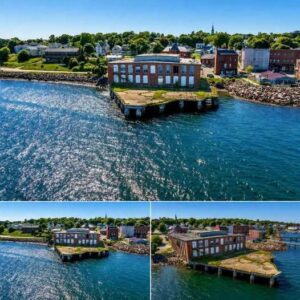
Along the waterfront of Eastport, Maine, an imposing old brick factory stands quietly beside Passamaquoddy Bay. Weathered by decades of coastal wind, rain, salt air, and changing seasons, the building may look forgotten today. Yet its aging walls preserve a story about a very different Maine—a Maine where coastal communities depended heavily on the sea for work, transportation, and survival.
The structure is more than an abandoned industrial building. It represents a period when the waterfront was at the center of community life and when factories, fishing boats, docks, and processing facilities were essential parts of the local economy.
Built during the early twentieth century, the factory reflects the architecture and working conditions of its era. Heavy timber, sturdy brick walls, and granite details give the building a remarkably durable appearance. Unlike many modern structures, its materials were chosen for strength and practicality, creating an industrial character that is difficult to reproduce today.
Time, however, has changed the appearance of the property.
The once-busy facility is now quiet. Surfaces have weathered, parts of the structure have deteriorated, and the surrounding landscape has taken on a different character. Instead of workers moving through the building and boats approaching the waterfront, there is an atmosphere of stillness.
That silence can make it difficult to imagine what the site was once like.
During Maine’s industrial waterfront era, coastal factories were often surrounded by activity. Fishing vessels brought their catches to shore, workers processed seafood, goods were packaged and stored, and shipments moved toward other communities and markets.
The sea was not simply part of the scenery.
It was part of the transportation system.
That is especially important when considering this factory’s location. The building sits directly beside Passamaquoddy Bay, and a concrete pier extends into the water. The pier provides a physical reminder of the relationship between the factory and the waterfront.
For a business connected to fishing and food processing, being located next to the water could be extremely practical. Materials could arrive by boat, finished products could be moved toward transportation routes, and the surrounding harbor provided direct access to a resource that had supported generations of Maine communities.
The property’s connection to the state’s sardine-canning industry makes the story even more compelling.
Sardines once played an important role in the economy and identity of coastal Maine. Canning plants provided employment and supported numerous related businesses. The industry connected small coastal communities with larger markets and helped create a network of fishermen, factory workers, boat operators, merchants, and transportation providers.
For many people living along the coast, the fishing and canning industries were not distant historical events. They were part of everyday life.
Factories like this one represented opportunity.
They provided jobs and gave coastal communities an economic reason to remain closely connected to the water. Their operations also shaped the physical landscape, with docks, piers, warehouses, processing buildings, and other industrial structures appearing along the shoreline.
Today, much of that industrial world has disappeared.
Some historic factories were demolished. Others were converted into different uses. Still others were abandoned as industries changed and older facilities became too expensive or impractical to maintain.
The Eastport factory remains as a physical reminder of that transformation.
Perhaps the most fascinating aspect of the property is the contrast between its industrial past and its surroundings.
Walk around the aging structure and the view opens toward Passamaquoddy Bay. Across the water lies Campobello Island, creating a landscape that seems almost completely removed from the factory’s working past.
The combination is striking.
In the foreground, there is brick, timber, granite, concrete, and evidence of decades of industrial activity.
Beyond it, there is open water, coastline, sky, and the natural beauty for which this part of Maine is known.
The contrast tells two stories at once.
One is a story of human industry—the workers, businesses, boats, and products that once depended on the waterfront.
The other is a story of the landscape itself.
The bay has remained, even as the industries surrounding it have changed. The water that once carried goods and supported fishing continues to shape the region today.
That may be one reason abandoned waterfront buildings can feel so haunting.
They show how quickly human activity can disappear while the surrounding landscape remains.
A factory can fall silent, a business can close, and generations of workers can move on. But the shoreline remains. The tides continue to rise and fall. The wind continues to move across the bay.
In that sense, the building exists between two eras.
Its architecture belongs to an industrial past, while its surroundings remain part of the enduring coastal landscape.
The property’s uncertain future adds another layer to its story.
Historic industrial buildings can be difficult to preserve. Their size and age can make restoration expensive, while exposure to coastal weather can create additional challenges. At the same time, demolition can permanently erase an important piece of local history.
That creates a difficult question for communities like Eastport.
Should an aging industrial building be restored and given a new purpose? Should its remaining structures be stabilized as historic evidence? Or should nature and time eventually be allowed to take their course?
There is no simple answer.
Preservation requires money, planning, and a practical reason to maintain the property. But once an old structure disappears, the physical connection to its history disappears with it.
The factory’s value therefore extends beyond its appearance.
It helps tell the story of the people who worked along Maine’s coast. It reflects an era when seafood processing was an important part of the regional economy. It shows how closely industry was connected to the water and demonstrates how Maine’s waterfront communities evolved over time.
For visitors, the property also offers something unusual.
It provides a chance to see the intersection of industrial history and natural beauty in one location. The weathered factory might initially draw attention because of its age, but the view across Passamaquoddy Bay gives the site an entirely different atmosphere.
The building may no longer be busy, but it has not lost its ability to tell a story.
Its brick walls can remind us of an era when Maine’s coast was filled with working factories. Its concrete pier hints at the boats and shipments that once connected the waterfront to the wider world. Its position beside the bay shows why the location was chosen in the first place.
And the distant view toward Campobello Island reminds us that while industries change, the landscape often remains.
The abandoned factory is therefore more than a relic.
It is a quiet piece of Maine’s forgotten industrial history, standing between the past and the present.
For anyone interested in the state’s coastal heritage, buildings like this offer an important lesson: history does not always survive inside museums or perfectly restored landmarks.
Sometimes it survives in places that appear forgotten.
Sometimes it is hidden behind weathered brick, beneath old timber beams, or beside a concrete pier disappearing into the water.
And sometimes, one of the best views of Maine’s past can be found by simply looking across the bay.