Some homes feel new the moment you walk through the door. Others feel like they have a story waiting to be discovered.
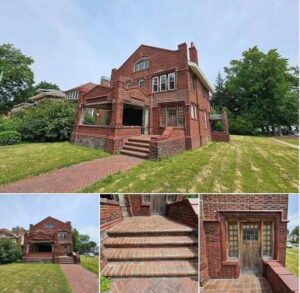
This remarkable historic all-brick home in Centralia, Illinois, belongs firmly in the second category.
From the outside, its stately brick construction and large covered front porch immediately create a timeless impression. Step inside, and the historic character continues with original wood staircases, high ceilings, oversized windows, and preserved architectural details that are increasingly difficult to find in modern construction.
The home manages to capture something many newer properties simply cannot recreate—the feeling that every room has lived through another era.
Original fireplaces add warmth and character, while the formal dining room features a traditional butler’s pantry, combining historic charm with useful storage and preparation space.
The spacious kitchen, meanwhile, offers an exciting opportunity for its next owner. Rather than completely sacrificing its historic personality, a future renovation could bring in modern finishes while keeping the features that make the house special.
And the possibilities don’t stop with the main living spaces.
Throughout the home, generous rooms provide plenty of flexibility for modern lifestyles. Whether the next owner imagines a traditional family residence, an entertaining space filled with friends and relatives, or a carefully updated historic retreat, the layout offers room to create something personal.
The oversized windows are another standout feature. In historic homes, windows were often designed to bring as much natural light as possible into the interior, creating bright and welcoming rooms during the day. Their proportions also contribute to the architectural character of the house, giving each room a sense of scale that is often missing from newer properties.
The original woodwork adds another layer of warmth. Details such as staircases, trim, doors, and other millwork can transform an older house from simply being old into something genuinely distinctive. These elements were created during a period when craftsmanship and durability were major considerations in residential construction.
That is one of the most appealing aspects of this property: it does not need to pretend to be historic. Its character is already there.
At the same time, owning a historic home does not mean giving up modern comfort. With thoughtful updates, the property could accommodate contemporary needs while preserving the architectural details that give it personality. A carefully planned kitchen renovation, refreshed bathrooms, updated lighting, improved storage, and modern systems could make the home significantly more comfortable without erasing its past.
The key would be balance.
Instead of replacing every older feature with something completely new, a renovation could celebrate the contrast between historic and contemporary design. Modern cabinetry, appliances, and fixtures could sit comfortably alongside original floors, woodwork, fireplaces, and doors. The result could feel both authentic and functional.
The home’s all-brick exterior is equally appealing. Brick has a durability and visual presence that has helped historic houses remain attractive for generations. Its rich texture and traditional appearance create an immediate sense of permanence, while the covered front porch adds an inviting transition between the street and the interior.
A front porch also offers something beyond aesthetics. It creates an outdoor room where residents can enjoy morning coffee, relax in the evening, or simply watch the activity of the neighborhood. Features like this are increasingly valued by buyers looking for homes with a stronger connection to traditional residential design.
Centralia itself adds another dimension to the property’s appeal. Located in southern Illinois, the community has a long history and a distinctive small-city atmosphere. Historic architecture remains an important part of communities like this, where older homes can provide a connection to previous generations while still serving the needs of today’s residents.
For someone who appreciates architecture, this type of property can be particularly exciting. There is a difference between purchasing a house that has been completely remodeled to look old and purchasing an actual historic residence that still contains original elements. In the latter case, the owner becomes part of the home’s continuing story.
Every staircase, doorway, fireplace, and window can serve as a reminder of the people who lived there before.
Of course, historic properties also require thoughtful ownership. Older homes can have maintenance considerations that newer construction does not, and prospective buyers should carefully evaluate the roof, foundation, electrical system, plumbing, heating and cooling systems, windows, masonry, and other major components. A professional inspection is especially valuable before taking on a renovation project.
But for the right buyer, those considerations may be outweighed by what cannot easily be recreated: authenticity.
Modern construction can reproduce the appearance of traditional architecture, but reproducing the feeling of age, craftsmanship, and genuine history is much harder. Original materials develop a character that comes naturally from decades of use and care.
That is why homes like this continue to attract attention.
The formal dining room, for example, offers more than a place to eat. Combined with the butler’s pantry, it reflects a style of entertaining that has largely disappeared from contemporary floor plans. Today, many homes favor open-concept kitchens and dining areas, while historic houses often separate these spaces in ways that create a more formal progression from one room to another.
Neither approach is necessarily better. They simply represent different ideas about how a home should function.
For a new owner, that contrast creates an opportunity. The house could retain its traditional dining room for special occasions while incorporating a more practical everyday kitchen. The historic rooms could remain elegant and largely untouched while other areas receive modern updates.
The same philosophy could extend throughout the property.
Rather than treating the house as a blank canvas, its future renovation could be approached as a conversation between past and present. Historic details could provide the foundation, while modern improvements make everyday life easier.
That approach is increasingly attractive to homeowners who want something more distinctive than a standard newly built property.
There is also something undeniably appealing about a house with imperfections. The marks of age, subtle variations in materials, and handcrafted details can make a property feel more personal. In a world filled with standardized construction, a historic home can offer an experience that feels individual.
This Centralia property appears to have many of those qualities.
It has the strong exterior presence of a traditional brick residence, the warmth of original woodwork, the elegance of fireplaces and a formal dining room, and the practical potential of rooms that can be adapted to contemporary living.
Most importantly, it offers a rare opportunity to become the next chapter in an existing story.
For buyers who value historic architecture but still want the freedom to modernize, that combination can be hard to resist. The home does not have to remain frozen in the past. Instead, it can evolve.
The best historic renovations do exactly that. They respect what came before while making thoughtful room for what comes next.
And perhaps that is what makes this all-brick Centralia home so intriguing. It is not simply a preserved piece of the past. It is a home with the potential to continue its story for another generation.