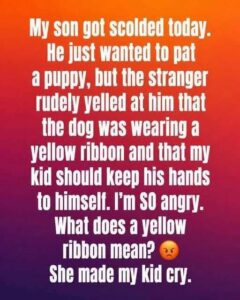
If you notice a yellow ribbon tied to a dog’s leash or collar, it may be more than a colorful accessory. For many dog owners, that small piece of yellow fabric is a quiet way of communicating an important message: please give this dog some extra space.
The yellow ribbon is commonly associated with the Yellow Dog Project, an initiative designed to encourage people to recognize when a dog may need additional distance from unfamiliar people, children, or other animals.
The most important thing to understand is that a yellow ribbon does not automatically mean a dog is aggressive or dangerous.
Instead, it can indicate that the dog needs extra consideration for a variety of reasons.
A dog wearing yellow may be recovering from an injury or illness. It may be nervous around unfamiliar people. It could be frightened by other dogs or overwhelmed by busy environments. Some dogs may be undergoing behavioral training, while others may simply need more personal space than the average dog.
For the owner, the ribbon can serve as a simple visual signal.
Rather than having to explain the situation to every person they encounter during a walk, the yellow ribbon communicates a basic request before an interaction takes place.
That request is simple:
Please don’t approach without asking.
For some dogs, unexpected encounters can be stressful.
Imagine a dog that is nervous around strangers walking through a crowded park. A well-meaning person might see the dog and immediately want to pet it. A child might run toward it. Another dog might approach while its owner assumes that all dogs enjoy meeting one another.
For a confident dog, these interactions may be completely ordinary.
For a fearful or recovering dog, they can be overwhelming.
Giving the dog additional space can make the situation much easier for everyone.
This is especially important during training.
Many owners work with their dogs on specific behaviors, such as remaining calm when another dog walks past, ignoring strangers, walking politely on a leash, or responding to commands despite distractions.
Training requires concentration.
When another person suddenly approaches or another dog comes within a few feet, the dog may become too distracted or anxious to respond appropriately.
Creating distance can give the owner enough room to redirect the dog and reinforce positive behavior.
The yellow ribbon can therefore be viewed as a courtesy signal rather than a warning label.
It tells other people that the dog may have specific needs at that moment.
Another important point is that the meaning of a yellow ribbon can vary somewhat from one owner to another. Not every person using yellow will have exactly the same reason. One dog might be recovering from surgery, another might be elderly, and another might simply be uncomfortable with strangers.
That is why the safest approach is not to guess.
If you see a dog wearing a yellow ribbon, don’t assume that you know why it is there.
Instead, give the dog and its owner some room.
If an interaction seems necessary, such as passing them on a narrow sidewalk, calmly give them as much space as practical. Avoid reaching toward the dog, staring directly at it, or allowing your own dog to rush over.
If you would like to pet the dog, ask the owner first.
The owner can decide whether an interaction is appropriate.
This is particularly important for children.
Children are naturally curious about dogs, especially when a dog looks friendly or approachable. Parents and caregivers can use a yellow ribbon as an opportunity to teach children that not every dog wants to be touched.
A simple lesson can make a significant difference:
Always ask before petting someone else’s dog.
Children should also learn to respect the dog’s body language.
A dog that turns its head away, backs up, hides behind its owner, licks its lips, yawns repeatedly, lowers its body, pins its ears back, or attempts to avoid contact may be uncomfortable.
These behaviors don’t necessarily mean the dog is dangerous.
They can mean the dog is asking for distance.
Understanding these signals can help prevent situations from escalating.
Dog owners also have an important responsibility.
A yellow ribbon should not be considered a substitute for responsible handling or training. Owners should still maintain control of their dogs, use appropriate equipment, follow local leash regulations, and take reasonable precautions based on their dog’s behavior.
The ribbon is simply an additional communication tool.
It can be especially useful in places where many people and animals share the same space.
Busy sidewalks, parks, outdoor markets, pet-friendly stores, and veterinary facilities can all create situations in which dogs encounter unfamiliar stimuli.
A dog that behaves perfectly at home may react differently when surrounded by strange people, unfamiliar animals, loud noises, bicycles, children, or traffic.
Stress can accumulate quickly.
Giving a dog space can help reduce that stress.
There is also a broader lesson behind the yellow-ribbon concept.
People sometimes assume that a friendly-looking dog wants to meet everyone.
But dogs, like humans, have different personalities.
Some are social and confident.
Some are cautious.
Some enjoy interacting with other animals but dislike unfamiliar people.
Others may have experienced trauma or simply never learned to feel comfortable in certain situations.
Respecting those differences is part of responsible dog ownership and responsible dog etiquette.
It’s also worth remembering that a dog’s behavior can change from one day to another.
A normally playful dog might be wearing a yellow ribbon because it is sick or injured. A dog recovering from a procedure may not want another animal bumping into it. An older dog may become less tolerant of sudden movements. A female dog may be experiencing circumstances that make interactions uncomfortable.
The ribbon gives the owner a way to communicate without sharing personal details.
Ultimately, seeing yellow on a dog’s collar or leash should encourage patience rather than fear.
It doesn’t necessarily mean, “This dog is dangerous.”
It is much closer to saying, “This dog needs some extra consideration right now.”
That small distinction matters.
Instead of approaching, allow the owner and dog to pass.
Instead of letting your dog pull toward them, shorten the leash and create distance.
Instead of assuming the dog wants attention, ask first.
And instead of judging the dog by its ribbon, remember that there may be a completely understandable reason behind it.
For dog owners, using a yellow ribbon can be a practical way to communicate a need that might otherwise be difficult to explain repeatedly.
For everyone else, recognizing the signal is an opportunity to be respectful and considerate.
A little extra space can make a nervous dog feel safer, help an owner maintain control, and prevent an unnecessary encounter.
So the next time you see a yellow ribbon on a dog’s collar or leash, don’t automatically assume the worst.
Pause.
Give the dog some room.
Respect the owner’s request.
And remember that the ribbon may simply be a polite message from someone who is trying to help their dog feel comfortable, safe, and successful in the world around them.